Kidney Disease, Insomnia and Sleepiness
A French study followed 2,765 adults with chronic kidney disease for 5 years. 22% reported insomnia and 15% daytime sleepiness, and both were linked more to symptoms like cramps, itching and fatigue than to kidney function.
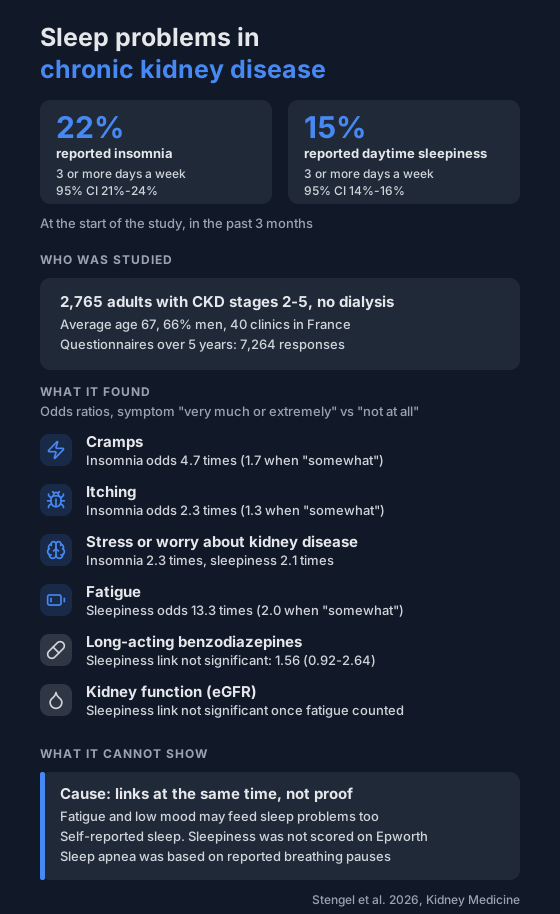
Poor sleep is common in people with chronic kidney disease (CKD), and it's often put down to the kidneys themselves. This study asked how much of it goes with kidney function, and how much with symptoms, other conditions and medicines.
The French CKD-REIN cohort followed adults with CKD for 5 years and asked about sleep every year or two. It found that sleep problems were linked more to symptoms than to the kidney numbers.
For a related post on overnight oxygen and the kidneys, see time below 90% and kidney risk in diabetes.
Who was studied?
- 2,765 adults with CKD stages 2 to 5, not on dialysis and not transplanted.
- Average age 67, 66% men.
- Recruited from 40 randomly chosen nephrology clinics in France, then followed from 2013 to 2020.
- They answered sleep questions at the start and at 1, 3 and 5 years, giving 7,264 sets of answers.
Insomnia meant sleeping poorly, plus trouble falling asleep, waking in the night or waking too early, on 3 or more days a week for 3 months. Daytime sleepiness meant feeling very sleepy during the day on 3 or more days a week.
How common were they?
At the start of the study:
- Insomnia: 22% (95% CI 21% to 24%). It was more common in women (30% against 19% of men) and less common with age.
- Daytime sleepiness: 15% (95% CI 14% to 16%).
- Sleep apnea: 15% reported breathing pauses in their sleep, and 14% had it on their medical record.
- Sleep length: 60% slept 7 to 9 hours.
Over 5 years, kidney function fell by about 7.5 mL/min/1.73 m2 on average. The share with each problem stayed similar at each visit, though insomnia crept up slightly (odds ratio 1.06 per year, 95% CI 1.00 to 1.11).
What went with insomnia?
These are odds ratios from the full model, adjusted for age, gender, other conditions and each other. For symptoms, they compare people bothered "very much or extremely" with people not bothered at all. The odds rose at each level: for cramps, 1.66 when somewhat bothered and 1.90 when moderately bothered.
- Cramps: 4.66 times the odds of insomnia (95% CI 3.28 to 6.62).
- Itching: 2.28 times (1.60 to 3.25).
- Stress or worry about kidney disease: 2.30 times (1.58 to 3.36).
- Low mood: 4.52 times (3.53 to 5.80), for a high depression score or antidepressant use.
- Sleep apnea: 1.55 times (1.14 to 2.10).
- Women compared with men: 1.77 times (1.30 to 2.42).
- Heart failure: 1.61 times (1.10 to 2.36).
Kidney function and albuminuria showed no significant link to insomnia. Thyroid hormone use went with more insomnia in the first models, but the link weakened and was not significant in the full one (1.39, 95% CI 0.95 to 2.03).
What went with daytime sleepiness?
- Fatigue: 13.3 times the odds when bothered very much or extremely (95% CI 8.07 to 22.0), with a step up at each level.
- Insomnia: 2.23 times (1.73 to 2.86).
- Low mood: 1.58 times (1.22 to 2.05).
- Sleep apnea: 1.64 times (1.22 to 2.21).
- Stress or worry about kidney disease: 2.11 times when bothered very much or extremely (1.45 to 3.06).
Lower kidney function did go with more sleepiness. Each 10 mL/min/1.73 m2 lower was linked to 1.16 times the odds (95% CI 1.05 to 1.28) after adjusting for social factors, activity, obesity, heart failure and long-acting benzodiazepines. Once fatigue and the other symptoms, low mood, insomnia and sleep apnea were added, it was no longer statistically significant (1.05, 95% CI 0.96 to 1.16).
What about medicines?
- 4% of people took a long-acting benzodiazepine.
- It went with more sleepiness in earlier models.
- In the full model it weakened and was not statistically significant (1.56, 95% CI 0.92 to 2.64).
The authors suggest that for people who do take benzodiazepines, shorter-acting types may leave less daytime effect. That is their discussion point, not something the study tested.
What can't it show?
- Cause. Sleep and the other measures were updated at the same visit, so the study can't tell which came first.
- Direction. Fatigue and low mood may both cause and result from poor sleep, as the authors note.
- Self-report. Sleep problems came from questionnaire answers, not a sleep recording.
- Sleepiness. It was measured with selected questions, not the Epworth scale, so it may be undercounted.
- Sleep apnea. It mostly reflects people who knew about it, so it is likely to be low.
- Missing data. Only 44% of the 7,264 sets of answers were complete, and the rest were filled in statistically.
- Funding. The cohort is partly funded by drug and dialysis companies, and five authors report ties to them. The paper states the funders had no role in the analysis.
What can you do with this?
If you have CKD and sleep badly, the study suggests it's worth noting cramps, itching, worry and tiredness alongside your sleep, not just your kidney results. A sleep diary or tracker lets you see how these line up over weeks.
An overnight oximeter shows oxygen and pulse while you sleep. It can't show insomnia, but it can show whether your oxygen dips on a given night. You can open a recording in the session viewer.
If sleep, itching, cramps or medicines are a problem, discuss them with your doctor.
Not a medical device. Does not diagnose, treat or prevent any condition. Discuss results and changes with a clinician.
References
- Stengel B, Moutard E, Metzger M, Jaussent I, Hamroun A, Laville SM, Omorou A, Fouque D, Massy ZA, Pecoits-Filho R, Frimat L, Alencar de Pinho N, Liabeuf S. Sleep Disturbances in Chronic Kidney Disease - The CKD-REIN Cohort Study. Kidney Medicine. 2026;8(11):101530. doi:10.1016/j.xkme.2026.101530