How Sleep Apnea Changes Over Time: A Review
A 2026 scoping review of 14 follow-up studies found that sleep apnea often clears in children, is often stable or slowly progressive in adults, and that weight loss was linked to less progression.
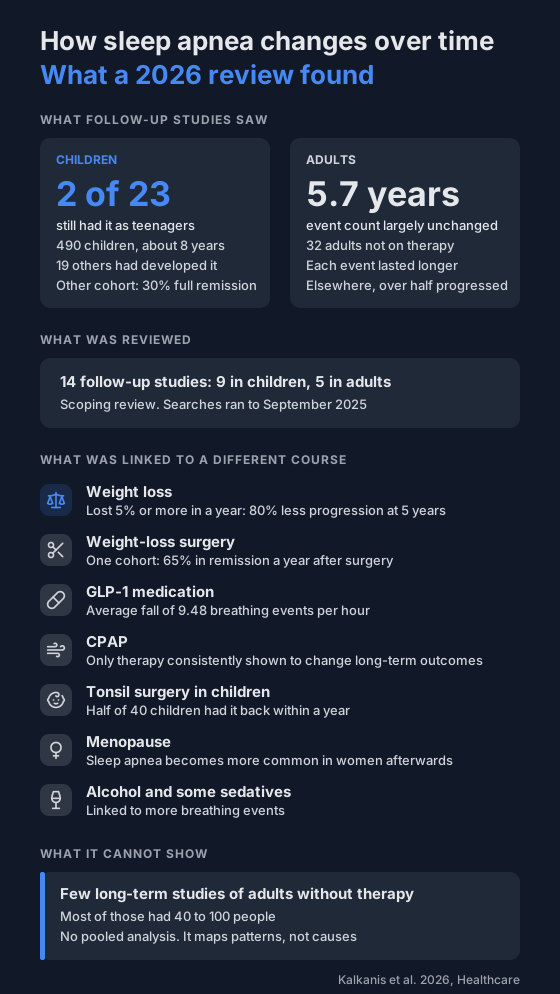
Sleep apnea is often described as something that only gets worse. A 2026 review of follow-up studies found a more mixed picture.
In children it often clears. In adults it's often stable or slowly progressive, and the review calls excess weight the most important risk factor you can change.
What did the review look at?
- A scoping review, with searches up to September 2025.
- 14 follow-up studies in the core set: 9 in children and 5 in adults.
What happens in children?
- In a US study of 490 children, 23 had sleep apnea at the start. About 8 years later, 2 of them still did, and 19 others had developed it.
- In a Hong Kong study of 243 children followed for about 10 years, 30% were in full remission.
- Half of 40 children had sleep apnea again within a year of tonsil and adenoid surgery. Weight gain and obesity were the reported predictors.
- Boys and children with a higher BMI were more likely to still have it later.
What happens in adults?
- 32 adults who declined therapy were followed for 5.7 years. Their event count and oxygen levels were largely unchanged, but each event lasted longer.
- In a clinic study of 55 adults, more than half progressed far enough to need therapy within about 17 months.
- Of 2,619 adults followed for about 5 years, nearly half changed symptom group.
- In women it becomes more common after menopause.
What was linked to a different course?
- Weight. In one study, losing 5% or more of body weight within a year was linked to 80% less progression over 5 years.
- Weight-loss surgery. In one cohort, 65% were in remission a year later.
- GLP-1 medication. One cited paper reported an average fall of 9.48 breathing events per hour.
- CPAP. The review calls it the only therapy consistently shown to change long-term outcomes. It works while it's used, and it was linked to modest weight gain.
- Alcohol and some sedatives. Both were linked to more breathing events. See alcohol and overnight oxygen.
What can't it show?
- The course without therapy in adults. People are offered therapy once sleep apnea is found, so long studies without it are rare. Most had 40 to 100 people.
- Cause. The authors didn't pool the numbers, and say their summary maps patterns, not causes.
What can you do with this?
One test is a single point in time. Weight, age and hormones shift, so ask your doctor when to re-check.
An overnight oximeter can't tell you whether you have sleep apnea. It can log your overnight oxygen for months, and you can share that with your doctor.
Not a medical device. Does not diagnose, treat or prevent any condition. Discuss results and changes with a clinician.
References
- Kalkanis A, Panou T, Archontogeorgis K, Steiropoulos P. The Natural History of Obstructive Sleep Apnea: A Scoping Review. Healthcare (Basel). 2026;14(3):325. doi:10.3390/healthcare14030325