Weight Gain After Tonsillectomy in Children
A 2026 review of 804 children who had their tonsils removed for sleep apnea found average BMI rose by 1.45 points over the next 12 months. It had no comparison group, so it can't separate surgery from ordinary growth.
Taking out the tonsils (tonsillectomy) is a common surgery for children with obstructive sleep apnea. Earlier studies disagree on whether children gain weight afterwards.
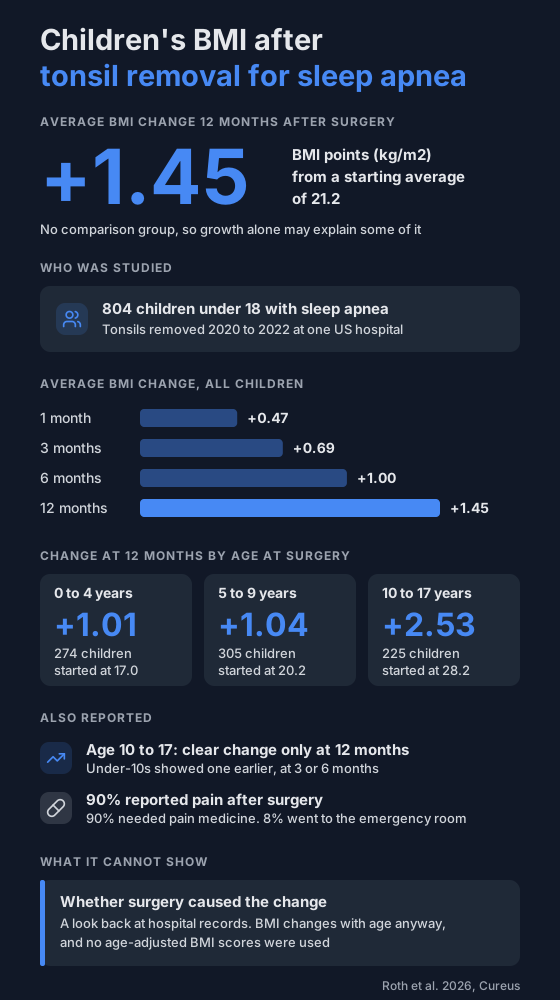
A September 2026 study of 804 children found average BMI was 1.45 points higher 12 months after surgery. It can't tell you whether surgery caused that.
Who was in the study?
- 804 children under 18 who had a tonsillectomy at one New Jersey hospital between January 2020 and January 2022.
- All had sleep apnea recorded before surgery, from a sleep study or a doctor's assessment alone.
- Their average age was 7.1 and their average BMI before surgery was 21.2.
This is a retrospective chart review: the researchers looked back through records for BMI at 1, 3, 6 and 12 months.
What happened to BMI?
Across all the children, the modelled average rose at every check:
- 1 month: +0.47
- 3 months: +0.69
- 6 months: +1.00
- 12 months: +1.45 (95% confidence interval 0.82 to 2.07)
Did age matter?
- Ages 0 to 4 (274 children, starting BMI 17.0): +0.86 at 6 months and +1.01 at 12 months.
- Ages 5 to 9 (305 children, starting BMI 20.2): +1.19 at 3 months and +1.04 at 12 months.
- Ages 10 to 17 (225 children, starting BMI 28.2): +2.53 at 12 months.
The other checks in each group showed no statistically significant change. Some earlier studies found the largest gains in younger children.
What else did they record?
The paper reports that 90% of the children had pain after surgery, 90% needed pain medicine and 8% went to the emergency department for pain.
The study didn't test why BMI might rise.
What doesn't it tell you?
- Cause. There was no group of children who didn't have surgery.
- Growth. BMI rises with age from about 5 or 6 anyway. The study didn't use age- and sex-adjusted BMI scores, so it can't separate the change from ordinary growth.
- Whether it matters. The authors say it's unclear whether the change affects health.
- The full picture. It was one hospital, not every child had a BMI on file at every check, and nothing was tracked after 12 months.
The study received no outside funding.
What can you do with this?
The authors suggest families be told about possible weight gain and that weight be checked at follow-up visits.
If your child snores most nights or you've seen pauses in their breathing, see a doctor. For the signs in adults, read snoring vs sleep apnea.
Not a medical device. Does not diagnose, treat or prevent any condition. Discuss results and changes with a clinician.
References
- Roth HJ, Balouch B, Rosen B, Nicolette M, Napoli L, Dibato J, Solomon D. Changes in Body Mass Index Following Pediatric Tonsillectomy for Obstructive Sleep Apnea. Cureus. 2026;18(9):e116877. doi:10.7759/cureus.116877