Home Oximeters in COVID: A Randomised Trial
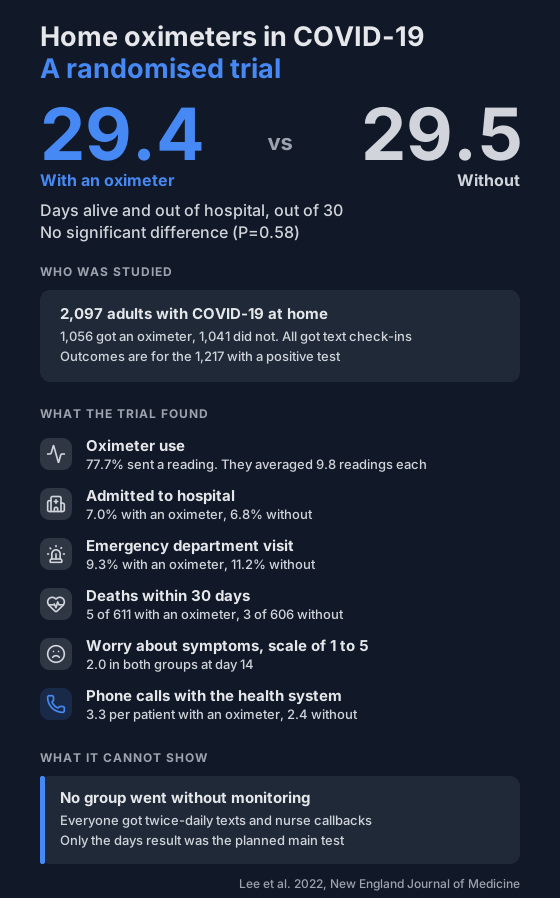
A 2022 trial gave 1,056 adults with COVID-19 a home pulse oximeter on top of text check-ins. Days alive and out of hospital were not significantly different from the group without one: 29.4 vs 29.5 out of 30.
Early in the pandemic, reports of "silent hypoxia" - low oxygen without feeling breathless - raised a question: should people check their oxygen at home instead of going by how breathless they feel? Many COVID-19 home-monitoring programs included a pulse oximeter.
A trial published in the New England Journal of Medicine in 2022 tested whether that changed anything. It found no significant difference in the main result: people with an oximeter spent about the same number of days alive and out of hospital as people without one.
Who was in the trial?
- 2,097 adults with COVID-19, monitored at home, in one six-hospital US health system.
- Their COVID-19 was either confirmed by a positive test or judged by their clinician.
- They were enrolled between 29 November 2020 and 5 February 2021.
- All of them were in COVID Watch, a 2-week program that sent a text twice a day asking about breathlessness, with a quick callback from a nurse when needed.
- 1,056 were randomly assigned to get a pulse oximeter as well, and were also monitored for a low or falling oxygen reading.
- 1,041 stayed on the text program alone.
The main result was measured in the 1,217 people whose COVID-19 was confirmed by a test: 611 with an oximeter and 606 without.
Did people use the oximeter?
Mostly.
- 77.7% of the oximeter group sent in at least one reading.
- Those who did sent 9.8 readings on average.
- They answered about 69% of the oximeter check-ins.
What did the trial find?
The main measure was days alive and out of hospital in the 30 days after enrolling.
- With an oximeter: 29.4 days on average.
- Without: 29.5 days on average.
- The difference was -0.1 days (95% confidence interval -0.4 to 0.2, P=0.58), which is not statistically significant.
A planned comparison of Black patients and non-Hispanic White patients also found no significant difference in that measure.
The other outcomes were exploratory, with the oximeter group first:
- Admitted to hospital: 7.0% vs 6.8%.
- Emergency department visit: 9.3% vs 11.2%.
- Deaths within 30 days: 5 (0.8%) vs 3 (0.5%).
- Worry about symptoms, on a scale of 1 to 5: 2.3 vs 2.3 at day 7, and 2.0 vs 2.0 at day 14.
- Office visits: 0.2 vs 0.2 per patient.
- Telemedicine visits: 0.5 vs 0.5 per patient.
- Phone calls with the health system: 3.3 vs 2.4 per patient.
The phone calls are the only exploratory outcome in the letter's table whose confidence interval excludes zero (difference 0.9, 95% confidence interval 0.4 to 1.3). The count covers all phone calls recorded in the health system, including nurse callbacks from the program. So the oximeter group had more recorded phone calls, and no significant difference in the main result.
What doesn't it tell you?
- Oximeter vs nothing. Both groups got twice-daily texts and nurse callbacks. The authors say it would not have been ethical to leave a group unmonitored. An earlier study linked the text program itself to better survival than no remote monitoring.
- Much about the exploratory outcomes. The authors say those confidence intervals were not adjusted for multiple comparisons and can't be used to infer an effect.
- Rare events. Only 8 of the 1,217 people died and 84 were admitted to hospital, so small differences there could be chance.
- Other places and times. It was one health system over one winter, from late 2020 to early 2021.
- Overnight recording. People sent spot readings at check-ins. The trial didn't look at continuous or overnight tracking, or at any condition other than COVID-19.
- The detail. It's a short letter. The methods and patient details are in a supplementary appendix.
What can you do with this?
If you're unwell and getting more breathless, get medical help. Don't wait for an oximeter reading to tell you to.
In this trial, adding an oximeter did not lead to more days alive and out of hospital than asking people how breathless they felt. If you do take spot readings at home, how you measure matters:
Not a medical device. Does not diagnose, treat or prevent any condition. Discuss results and changes with a clinician.
References
- Lee KC, Morgan AU, Chaiyachati KH, Asch DA, Xiong RA, Do D, Kilaru AS, Lam D, Parambath A, Friedman AB, Meisel ZF, Snider CK, Chisholm DL, Kelly S, et al. Pulse Oximetry for Monitoring Patients with Covid-19 at Home - A Pragmatic, Randomized Trial. New England Journal of Medicine. 2022;386(19):1857-1859. doi:10.1056/NEJMc2201541