Galaxy Watch 6 SpO2 in Older Adults: A Study
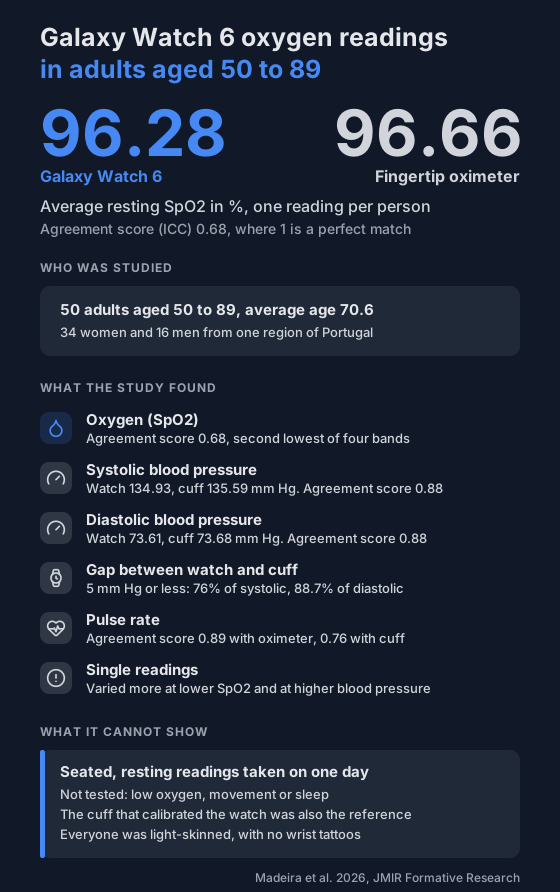
A 2026 study compared a Galaxy Watch 6 with a fingertip oximeter and a blood pressure cuff in 50 adults aged 50 to 89. Average oxygen readings were close, but single readings varied.
Some smartwatches now show blood oxygen and blood pressure. A small study published in May 2026 tried a Samsung Galaxy Watch 6 on people aged 50 to 89.
It compared the watch's oxygen and blood pressure readings with a fingertip oximeter and an upper-arm cuff.
Who was in the study?
- 50 adults from one region of Portugal.
- Average age 70.6. 34 were women and 16 were men.
- People with wrist tattoos, or whose watch couldn't be calibrated, were left out.
Everyone sat and rested first. Each watch was calibrated against the study's cuff, then blood pressure was taken three times with both devices. SpO2 was taken once, with the watch and a fingertip oximeter at the same time.
What did it find for oxygen?
- Average SpO2 was 96.28% on the watch and 96.66% on the fingertip oximeter.
- That difference wasn't statistically significant (P=.10).
- The agreement score (ICC) was 0.68, where 1 is a perfect match. That's the second lowest of the four bands the authors used.
- Single readings spread more at lower SpO2 values.
The authors say the watch may suit following a trend in stable people at rest. They also say its SpO2 readings aren't interchangeable with a clinical-grade oximeter's, and aren't enough to base medical decisions on. They say part of the spread may come from the wrist, which is more affected by skin temperature and blood flow than the finger.
And blood pressure?
- Averaged over three readings, the watch gave 134.93/73.61 mm Hg and the cuff 135.59/73.68.
- The agreement score was 0.88 for both numbers.
- 76% of systolic and 88.7% of diastolic readings were within 5 mm Hg of the cuff.
- Taken one reading at a time, diastolic differed significantly in all three rounds and systolic in the first.
- Single readings varied more at higher blood pressures.
What doesn't it tell you?
- Low oxygen. Average readings were above 96%. The authors call for tests at lower values.
- Sleep or movement. Everything was measured seated and resting, on one day.
- Other skin tones. Everyone was light-skinned. See pulse oximeters and skin tone.
- Independent blood pressure. The cuff that calibrated the watch was also the reference, which the authors say may inflate agreement. The watch and cuff were on opposite arms.
What can you do with this?
Going by this study, a watch SpO2 reading taken at rest is an approximate figure. The study didn't test overnight use. Smartwatch SpO2 vs a pulse oximeter covers the differences.
If a reading worries you, talk to a doctor.
Not a medical device. Does not diagnose, treat or prevent any condition. Discuss results and changes with a clinician.
References
- Madeira R, Esteves D, Neiva H, Maia A, Rondão C, Pinto N, Vercelli A, Pato MV. Reliability and Safety of Smartwatch Blood Pressure and Oxygen Saturation Measurements in Older Adults: Instrument Validation Study. JMIR Formative Research. 2026;10:e81955. doi:10.2196/81955