Everest in Four Days After Tent Sleep
A 2026 case report describes one recreational climber who slept 48 nights in a hypoxic tent, then went from New York to the Everest summit in 3 days 23 hours with supplemental oxygen. Finger oxygen readings ran from 88% at base camp without oxygen to 70% at the summit on 3 litres per minute.
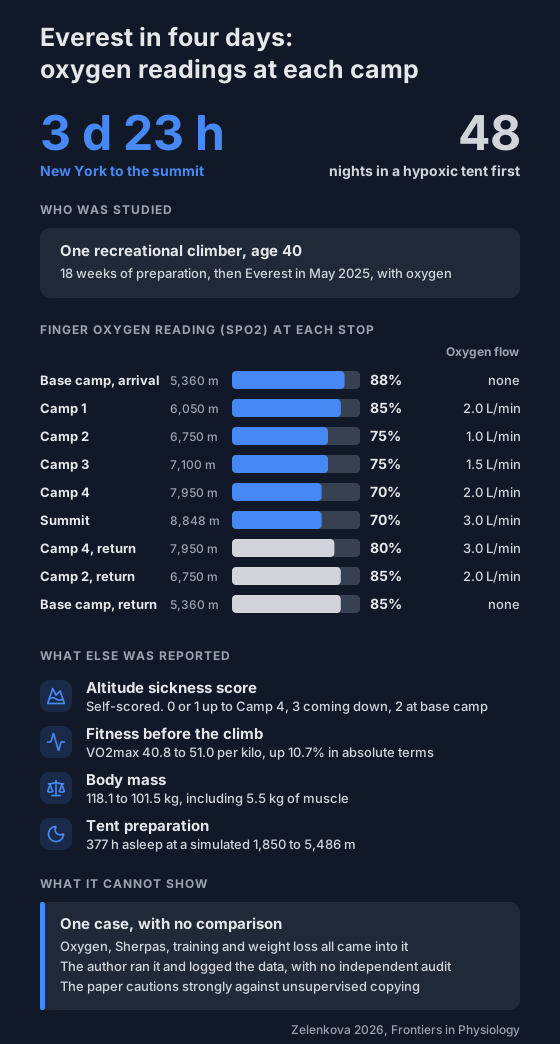
A typical Everest expedition takes 40 to 50 days, because climbers make repeated trips between camps to adjust to the thin air. A 2026 case report describes one man who skipped that stage. He prepared at home for 18 weeks, then went from New York to the summit in 3 days 23 hours.
This is a single case, and nothing here is a recommendation. The author strongly cautions against copying it without equivalent preparation, expert medical supervision and safety infrastructure.
Who was studied?
- One recreational climber, age 40, with no athletic career.
- He had climbed before, including a 2024 Everest attempt that ended at 8,550 m when recurring vision loss forced him down.
- Two months before the 2025 trip he had four fractures in an avalanche in Ecuador. His supervising doctor cleared him to go.
- His supervising doctor, who is also the paper's author, ran his medical checks and training.
- Before the preparation he had a heart scan, stress test and blood tests.
- He was 118.1 kg at the start, with a VO2max (a measure of fitness) of 40.8 ml/kg/min.
What did the preparation involve?
- 48 nights sleeping in a hypoxic tent, about 377 hours. The tent simulated altitudes from 1,850 m to 5,486 m, rising over the weeks.
- 16 exercise sessions on a treadmill or stair machine while breathing low-oxygen air through a mask, about 34 hours, up to a simulated 6,000 m.
- About 210 to 220 hours of training in total, with a two-week taper before departure.
- His oxygen and pulse were tracked with finger oximeters during sleep and training.
- Before he left, he weighed 101.5 kg, down 16.6 kg, and his VO2max was 51.0. That is 25% higher per kilo. The paper notes that in absolute terms VO2max rose 10.7%, and that part of the larger per-kilo gain came from the weight loss. He also lost 5.5 kg of muscle.
What did the oxygen readings show?
The climb began at base camp (5,360 m) with no rest days and no time at the higher camps first. He used supplemental oxygen from base camp onward, starting at 0.5 litres per minute and changing the flow by camp, up to 3.0 for the summit push. The paper recorded one finger reading at each stop, at rest, after a one-minute settling period.
- Base camp on arrival, 5,360 m: 88%, no oxygen.
- Camp 1, 6,050 m: 85%, 2.0 L/min.
- Camp 2, 6,750 m: 75%, 1.0 L/min.
- Camp 3, 7,100 m: 75%, 1.5 L/min.
- Camp 4, 7,950 m: 70%, 2.0 L/min.
- Summit, 8,848 m: 70%, 3.0 L/min.
- On the way down at 7,950 m: 80%, 3.0 L/min.
- On the way down at Camp 2, 6,750 m: 85%, 2.0 L/min.
- Back at base camp, 5,360 m: 85%, no oxygen.
The aim of the oxygen was to keep SpO2 above 70%, and the Camp 4 and summit readings were 70%. His heart rate was 95 to 110 bpm wherever it was recorded above base camp, and 62 bpm at base camp.
Leaving New York to reaching the summit took 3 days 23 hours 7 minutes. The paper calls this "sea to summit" and counts it from his New York departure, with a stop in Istanbul and a helicopter leg from Kathmandu to base camp. The climb from base camp to the summit took 60 hours 22 minutes.
For how finger readings behave at altitude in general, see blood oxygen at altitude.
What about altitude sickness?
- On the Lake Louise score (a 0 to 12 symptom checklist, self-scored at each camp), he scored 0 or 1 at every stop from base camp to Camp 4.
- The paper did not record a score at the summit because of conditions.
- On the way down, at about 8,000 m and again at Camp 2, he scored 3, with a headache and fatigue. That met the criteria for the lower grade of acute mountain sickness.
- At base camp he scored 2, from fatigue, and no longer met the criteria.
- The author notes that exhaustion and lack of sleep make the fatigue part hard to attribute to altitude.
- He had no brain or lung swelling from altitude.
- He carried dexamethasone and acetazolamide for emergencies and did not use them.
What are the safety risks?
The paper is direct about these:
- It says the result is not a validated protocol, and it cautions strongly against unsupervised replication.
- The climber had cardiac and blood checks beforehand, medical supervision throughout, set limits for turning back, and a guide team.
- Climbing this fast with no on-mountain adjustment carries a risk of altitude sickness, brain swelling and lung swelling. The paper says controlled studies are needed to find the safety limits.
- The oxygen plan used low flows from the start of the climb. The paper calls this approach novel and says its separate effect is unknown.
- Time above 7,000 m with no rest was about 40 hours, and symptoms appeared on the descent.
What can't one case show?
- Cause. There was no comparison. The paper says the result cannot be put down to the tent alone, because supplemental oxygen, Sherpa support, training, weight loss and his own tolerance all came into it.
- Whether it works for others. One highly selected, closely supervised man says little about anyone else.
- Checked data. The summit and timeline were backed by GPS, the guide company's records and a summit certificate. The preparation logs and the oxygen, pulse and Lake Louise data were recorded and interpreted by the author, with no independent audit.
- Who ran it. The author was also the supervising doctor and designed the programme, using what the paper calls a patented methodology. The paper's conflict of interest statement declares no commercial or financial relationships.
- How it works. The paper did not measure red blood cell mass, breathing response or blood gases, so any explanation is speculation.
- Study type. The data came from routine coaching and were compiled after the trip, not from a planned study.
The author says controlled studies are needed to find the minimum effective dose of low-oxygen exposure and its safety limits.
What can you do with this?
If you're planning a high-altitude trip, talk to a doctor who knows altitude medicine before you plan anything. For what controlled trials found about pre-acclimatising, read pre-acclimatising for altitude: how long?.
An oximeter shows what your SpO2 and pulse did. It can't tell you whether a trip is safe for you, and you can share your readings with your doctor.
Not a medical device. Does not diagnose, treat or prevent any condition. Discuss results and changes with a clinician.
References
- Zelenkova I. Breaking limits: rapid sea-to-summit ascent of Mount Everest (8,848 m) in 3 days 23 hours following normobaric-hypoxic pre-acclimatization and staged supplemental oxygen in a non-elite athlete. Frontiers in Physiology. 2026;17:1873293. doi:10.3389/fphys.2026.1873293