Dialysis, Extra Fluid and Sleep Apnea
A 2026 Korean study tested 40 dialysis patients with daytime sleepiness. 30 of them (75%) had 5 or more breathing events per hour on a level 4 test, and more extra body fluid went with more events.
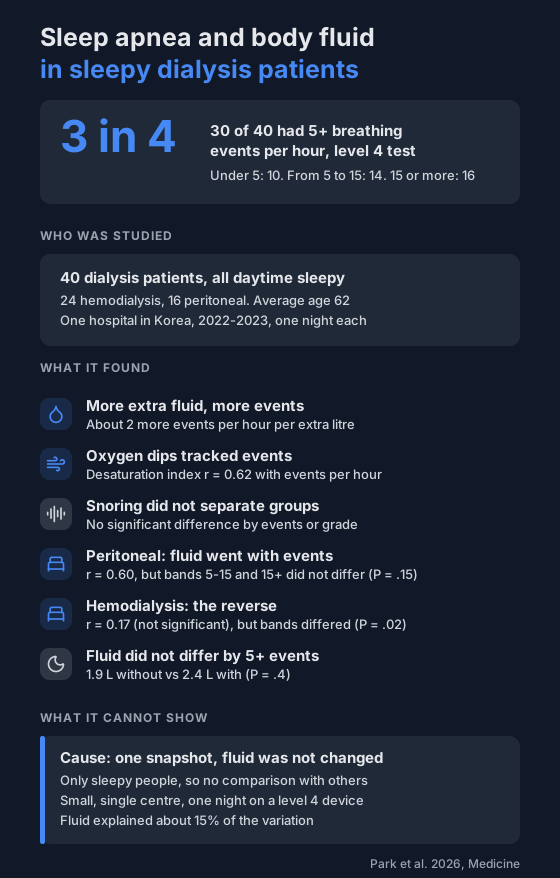
Sleep apnea is thought to be common in people on dialysis, but it often doesn't come with loud snoring. This small Korean study looked at dialysis patients who were already sleepy in the daytime. It counted how many had sleep apnea on an overnight test, and whether extra body fluid lined up with it.
Fluid is one of the things a dialysis team tracks. This study only measured it, and the paper doesn't test changing it.
For related posts, see kidney disease, insomnia and sleepiness and time below 90% and kidney risk in diabetes.
Who was studied?
- 40 dialysis patients: 24 on hemodialysis and 16 on peritoneal dialysis.
- 21 men and 19 women, average age 62, average body mass index 25.
- They had been on dialysis for an average of 55 months.
- 85% had high blood pressure and 47.5% had diabetes.
- All of them were sleepy in the day, with a score above 10 on the Epworth Sleepiness Scale (the paper's sleepiness questionnaire). The methods also say 10 or more, so the cutoff isn't clear.
- They came from one hospital in Busan, Korea, between January 2022 and January 2023. Of 213 patients, 62 met the criteria and 40 were enrolled.
- People on sedatives, sleeping pills, gabapentin, pregabalin or antihistamines were left out, as were people with unstable heart disease.
Each person wore a level 4 sleep test for one night. That is the simplest type of test, and it records airflow, oxygen, pulse, snoring and movement. Hemodialysis patients wore it on a dialysis day. Peritoneal dialysis patients wore it on any day. Body fluid was measured after enrolment with a body composition monitor, which reports extra fluid in litres.
How many had sleep apnea?
- 30 of 40 (75%) had 5 or more breathing events per hour.
- It was 75% in both groups: 18 of 24 on hemodialysis and 12 of 16 on peritoneal dialysis.
- 14 had 5 to under 15 events per hour, and 16 had 15 or more.
- 10 had under 5.
The paper counts 5 or more events per hour as sleep apnea. People with 5 or more events had a higher oxygen desaturation index than those with fewer: 12.0 against 2.7 (P < .01).
What went with the number of events?
Among people with 5 or more events, as the paper labels these results:
- Oxygen desaturation index: events per hour went with it (r = 0.62, P < .01). The oxygen desaturation index is the count of oxygen dips per hour.
- Extra body fluid: events per hour went up with fluid (r = 0.41, P = .009). That P value fits all 40 people, not the 30 with events, so the label may be wrong. In a regression across all 40, each extra litre went with about 2 more events per hour. Fluid explained about 15% of the variation between people.
Extra fluid did not separate people with and without sleep apnea. It averaged 1.9 L without and 2.4 L with 5 or more events (P = .4). It did differ between the two bands above 5 in the paper's table: 1.5 L at 5 to 15 events and 3.1 L at 15 or more (P = .01). The results text prints the second figure as 31.2, which looks like a typo.
In the paper's tables, snoring, age and body mass index did not differ by events, so the authors found no easy sign other than sleepiness. One sentence in the results reads as if fluid, age, snoring and others did differ, but the tables and the discussion say they didn't.
Did it differ by dialysis type?
The answer changes with the test used.
- Peritoneal dialysis: fluid went with events per hour (r = 0.60, P = .01). In a regression it was the only independent predictor, and time on dialysis added to it. But fluid didn't differ significantly between the 5-to-15 and 15-or-more bands (2.0 L against 3.8 L, P = .15, 6 people in each).
- Hemodialysis: the link was not significant (r = 0.17, P = .4). Yet fluid was higher in the 15-or-more band than the 5-to-15 band (2.7 L against 1.2 L, P = .02, 10 and 8 people).
The paper labels both correlations as people with events (12 and 18), but the P values fit the whole groups (16 and 24). The abstract leans on the regression and links fluid to events mainly in peritoneal dialysis. The discussion leans on the band comparison and says only the hemodialysis group matched the overall result. The 5-to-15 hemodialysis band was also older (76 against 62 years).
What can't it show?
- Cause. It is a cross-sectional study with one test on one night, so it can't say whether fluid leads to more events or the other way round. Nobody's fluid was changed.
- How sleepiness relates. Everyone was sleepy, so there is no comparison with people who weren't. The authors suggest the questionnaire could flag who to test further, but this design can't test that.
- Size. 40 people at one hospital, and the smallest subgroups held 6 people. The authors say it may not apply to other dialysis patients.
- Selection. Only people willing to complete the questionnaire were included, which the authors say may bias the 75%.
- Measurement. A level 4 device, not a full lab sleep study, on one night. Hemodialysis patients were tested on a dialysis day and peritoneal patients on any day.
- Funding. The authors declare none.
The authors suggest managing fluid as a target for sleep apnea in dialysis patients. The study did not test that.
What can you do with this?
If you are on dialysis and sleepy in the day, this study suggests sleep apnea is common in that group. A record of your own oxygen and pulse over several nights can add to what you tell your care team.
An overnight oximeter shows oxygen dips and pulse. It can't show fluid levels, and it isn't a sleep study. You can open a recording in the session viewer, and the sleep apnea risk check is a short checklist.
Questions about fluid, dialysis or sleepiness belong with your dialysis team.
Not a medical device. Does not diagnose, treat or prevent any condition. Discuss results and changes with a clinician.
References
- Park S, Heo CM, Park BS, Ko JH, Park KM, Lee JG, Kim YW. Over-hydration as a key modifiable predictor of obstructive sleep apnea severity in dialysis patients with daytime sleepiness. Medicine (Baltimore). 2026;105(36):e50524. doi:10.1097/MD.0000000000050524