CPAP Cheyne-Stokes Data Before Heart Events
A 2026 look back at 1,265 CPAP users' data: alert rules built on the nightly Cheyne-Stokes percentage flagged 23 of 25 heart and stroke events, a median 12 days before a cut-off set 3 days before care. Here's what it can and can't show.
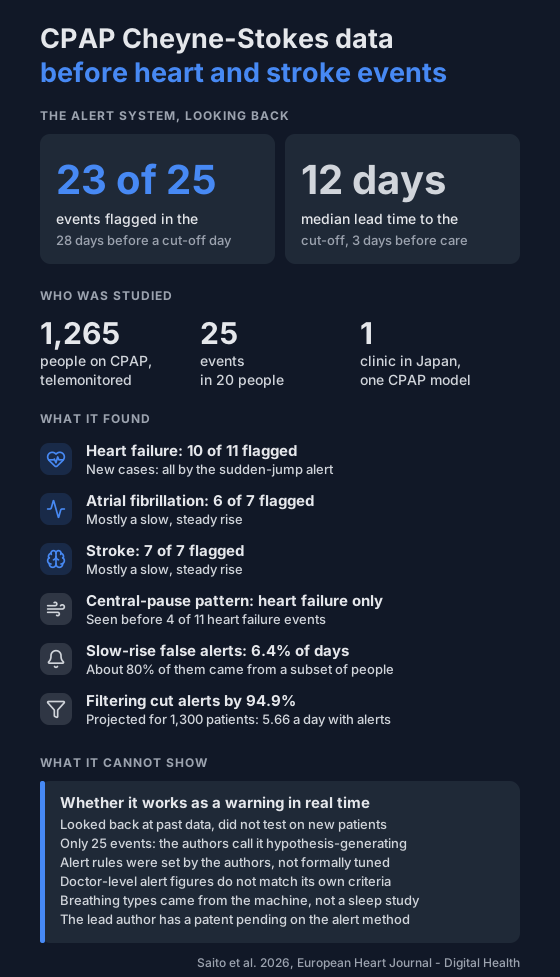
Some CPAP machines log a nightly Cheyne-Stokes breathing percentage. Earlier research has linked Cheyne-Stokes breathing to heart failure and other heart problems. A 2026 study from a sleep clinic in Japan asked whether changes in that number show up before heart and stroke events.
What is Cheyne-Stokes breathing?
It's a pattern where breathing swells, fades, then pauses, over and over. CPAP machines estimate it from airflow, and they can get it wrong. For one example, see a CPAP machine that flagged Cheyne-Stokes because of a blocked nose.
Who was studied?
- 1,265 people with obstructive sleep apnea on CPAP at one clinic in Japan.
- All used the same Philips DreamStation Auto BiPAP machine, with data sent to the clinic every day.
- Data ran from August 2024 to December 2025.
- 20 of them had 25 heart or stroke events: 11 heart failure, 7 atrial fibrillation and 7 strokes.
- An event meant a hospital admission or outpatient intervention for one of those.
How did the alert system work?
The authors built a set of alert rules and ran them over the stored data, looking back.
- They smoothed each person's nightly Cheyne-Stokes percentage into a 3-day average.
- They compared it with that person's own earlier level, not a fixed cut-off.
- One alert looked for a slow, steady rise above that level.
- A second looked for a sudden jump above the past week.
- A doctor-level alert also needed a central-pause pattern on 2 or more days: at least 5 central pauses an hour, making up at least half of breathing events.
- A central pause is when breathing stops with the airway open.
They counted an event as flagged if an alert came in the 28 days before a cut-off day. The cut-off day was set 3 days before the admission or intervention.
What did it find?
- 23 of the 25 events (92%) were flagged.
- That was 10 of 11 heart failure events, 6 of 7 atrial fibrillation events and all 7 strokes.
- The median lead time was 12 days before the cut-off day, with half of events between about 3 and 24 days.
- With the stricter doctor-level rule, the paper reports 72% flagged (18 of 25), a median 6.5 days before the cut-off day.
- That figure doesn't fit the paper's own results: it says the central-pause pattern the rule needs was seen in only 4 events.
The patterns differed by condition.
- Atrial fibrillation and stroke mostly showed a slow, steady rise.
- Every new case of heart failure was flagged by the sudden-jump alert.
- Longstanding heart failure more often showed a slow rise.
- The central-pause pattern was seen only before heart failure, in 4 of 11 events.
What about false alarms?
An alert outside the 28-day window counted as false.
- The slow-rise alert fired falsely on 6.40% of days checked, and the sudden-jump alert on 0.51%.
- About 80% of the slow-rise false alert days came from a subset of people.
- The authors think repeated alerts in the same people might mean something, but the paper doesn't test that.
- Their filtering cut alerts by 94.9%.
- They estimate a 1,300-person clinic would see alerts for about 5.66 people a day.
The paper doesn't say how many people without an event got an alert, or what share of alerts were followed by an event.
How strong is the evidence?
Early, and the authors say so.
- It looked back at past data. It didn't warn anyone in real time or test the rules on new patients.
- 25 events is a small number. The authors call the results hypothesis-generating and a proof of concept, not a validation.
- The authors set the alert rules from physiology and their own look at the data, not by formal tuning, and say the rules need refining.
- One clinic and one CPAP model, so it may not apply to other machines.
- Breathing types came from the machine's own count, not a sleep study.
- Some people had more than one event, and the authors say that may not be fully accounted for.
- The lead author has a patent pending on the alert method. The study had no outside funding.
What can you do with this?
This was a clinic's research system, not something to copy from your own CPAP app. Don't read your nightly Cheyne-Stokes number as a warning sign or an all-clear. If something new shows up in your CPAP report, take it to your sleep clinic.
See what the CPAP log misses and tracking your oxygen alongside CPAP.
Not a medical device. Does not diagnose, treat or prevent any condition. Discuss results and changes with a clinician.
References
- Saito K, Takamatsu Y. Time-structured detection of pre-event cardiovascular instability using CPAP-derived Cheyne-Stokes breathing. European Heart Journal - Digital Health. 2026;7(7):ztag108. doi:10.1093/ehjdh/ztag108