Sleep Apnea and Children's Height: 2026 Study
A 2026 study of 2,443 children found that more sleep time below 90% oxygen went with lower height for age. The number of breathing events per hour did not, once oxygen was accounted for.
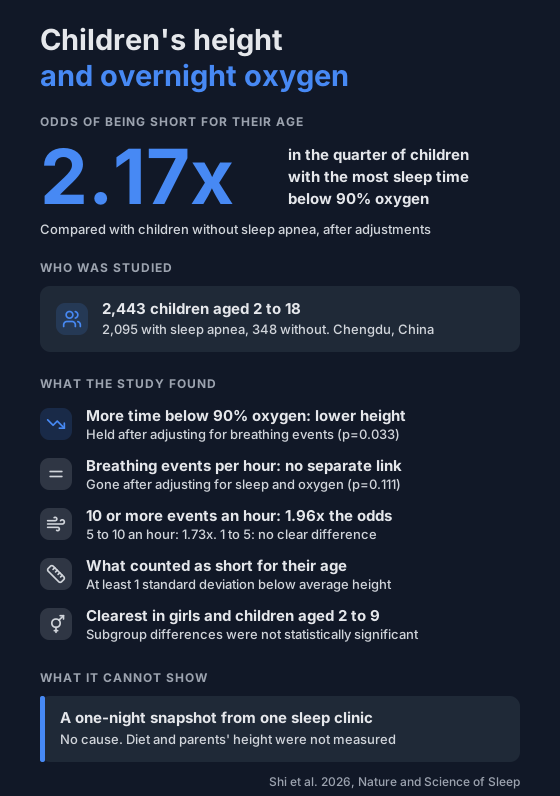
Slow growth is a listed sign of sleep apnea in children. A 2026 study asked which overnight number lines up with height: how often breathing is disturbed, or how long oxygen stays low. Low oxygen was more consistent.
Who was studied?
- 2,443 children aged 2 to 18, referred to one sleep centre in Chengdu, China, between 2013 and 2025 for snoring or mouth breathing.
- Each had one lab sleep study, with height measured that night.
- 2,095 had obstructive sleep apnea, meaning at least 1 breathing event per hour. The other 348 were the comparison group.
What was measured?
- Breathing events per hour.
- T90. The share of sleep time with oxygen below 90%.
- Height for age. How far a child's height sits from the average for their age and sex.
The study counted a child as short for their age at 1 standard deviation or more below average. Only 1.09% met the usual short stature cut-off of 2 standard deviations below.
What did it find?
- More time below 90% went with lower height for age (p=0.033), after adjusting for age, sex, BMI, sleep stages and breathing events per hour.
- The gap was small: each extra point of T90 went with a 0.005 lower height score.
- Breathing events per hour had no separate link once sleep stages and oxygen were accounted for (p=0.111).
- The quarter of children with the most time below 90% had 2.17 times the odds of being short for their age, against children without sleep apnea.
- Children with 10 or more events an hour had 1.96 times the odds. Those with 5 to 10 had 1.73 times, and 1 to 5 showed no clear difference.
Was it the same for every child?
The pattern was clearest in girls and in children aged 2 to 9. Girls with 10 or more events an hour had 4.77 times the odds. No group of boys showed a clear difference.
Tests found no statistically significant difference between subgroups, and the authors call these results exploratory.
What can't it show?
- It's a cross-sectional snapshot, so it can't show that low oxygen slows growth. The authors say the link could run the other way.
- Diet, exercise, parents' height and genetics weren't measured.
- One clinic, and one lab night per child.
Chinese government grants funded the study.
What can you do with this?
The authors suggest height checks every 6 to 12 months for children with sleep apnea, and say that needs testing.
If your child snores most nights and is dropping down the growth chart, mention both to their doctor. Home oximetry is not a sleep study.
Not a medical device. Does not diagnose, treat or prevent any condition. Discuss results and changes with a clinician.
References
- Shi Y, Chen Z, Feng X, Lei F, Tan L, Li T, Zhou J, Sun Y, Zhang Y, Ren R, Jiao J, Li Y, Wang Y, Sanford LD, et al. Nighttime Respiratory Disturbance and Hypoxemia Associated with Impaired Linear Growth in Children with Obstructive Sleep Apnea. Nature and Science of Sleep. 2026;18:631079. doi:10.2147/NSS.S631079