CBT for Sleep in Diabetes: A Meta-Analysis
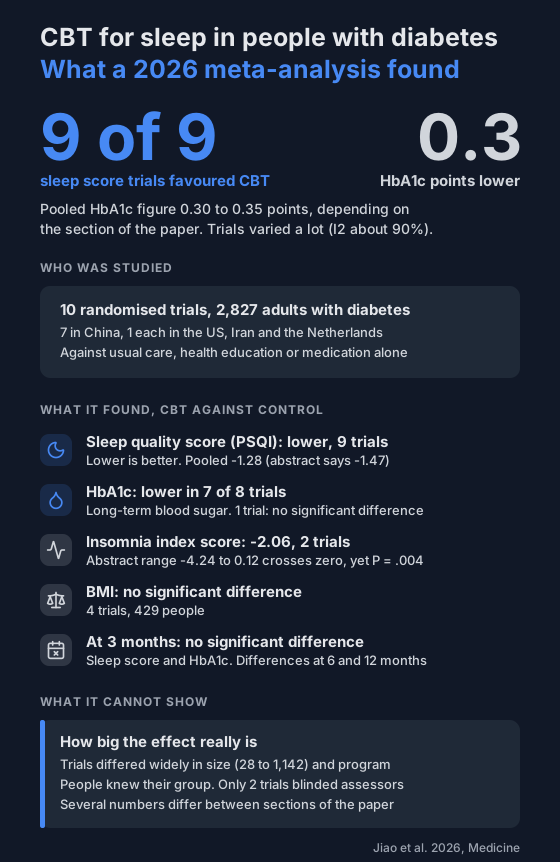
A 2026 meta-analysis of 10 randomised trials (2,827 people with diabetes) found lower sleep quality scores and HbA1c with CBT, no change in BMI, and very large differences between trials.
Poor sleep is common with diabetes. Research cited in this review puts sleep problems at about 47% of people with diabetes. Cognitive behavioural therapy for insomnia (CBT-I) is the first-line option in sleep guidelines.
A meta-analysis published in October 2026 pooled the trials of CBT in people with diabetes. It looked at sleep and also at long-term blood sugar (HbA1c) and weight.
Who was studied?
- 10 randomised trials with 2,827 adults with diabetes in total.
- 7 trials were in China, 1 each in the US, Iran and the Netherlands.
- Trial sizes ranged from 28 to 1,142 people, and average ages from 29 to 72.
- Most had type 2 diabetes. Two trials were in pregnancy: one in gestational diabetes, one in women with diabetes and postpartum depression.
- The programs varied: weekly lectures with discussion, a 5-week online CBT-I course, CBT added to medication, and individual sleep education.
- The comparison was usual care, health education or medication alone.
What did it find?
Sleep quality was measured with the PSQI, a 0 to 21 score where lower means better sleep.
- Sleep quality score: all 9 trials that measured it reported a significantly lower score with CBT. The pooled effect was -1.28 in the results section (95% CI -1.74 to -0.82), and -1.47 in the abstract.
- HbA1c: 8 trials measured it, and 7 reported a significant drop. The authors put the pooled drop at 0.30 to 0.35 percentage points.
- Insomnia index score: -2.06 from only 2 trials.
- BMI: no significant difference, from 4 trials and 429 people.
That HbA1c drop is similar in size to what diabetes lifestyle programs achieve, the authors say.
Did the effect last?
The paper split the results by follow-up time.
- Right after the program: sleep score and HbA1c were both lower with CBT.
- At 3 months: no significant difference for either, from 2 to 3 trials.
- At 6 and 12 months: both were lower again, though the 12-month results come from only 2 trials.
How much do the trials agree?
Not much. The I2 figure measures how much trials differ beyond chance, and anything over 75% counts as high.
- Sleep quality score: 89% to 91%.
- HbA1c: 90% to 94%.
- Insomnia index score: 88%.
So the trials gave quite different results, and one pooled number hides that. The authors tested disease type, trial size and the program used, and none of them explained the spread.
Are the numbers in the paper consistent?
Not fully, so read the direction of the results rather than the exact sizes.
- The sleep score effect is -1.28 in the results and -1.47 in the abstract.
- The paper calls these standardised effects in one place and plain score differences in another, so -1.28 may not mean 1.28 PSQI points.
- The abstract's range for the insomnia index score crosses zero, yet the paper calls it significant.
- The paper counts 10 trials, but its tables list only 9.
What can't it show?
- How big the effect is. The spread between trials is very large, and two trials from China make up about 70% of the people.
- Blinding. People knew whether they got CBT, and only 2 trials blinded the people scoring the results.
- Allocation. Only 2 trials described how they kept group allocation hidden.
- Certainty. The authors rate the evidence as low, or at best the second highest of four grades.
- Other languages. Only papers in English or Chinese were included.
- Sleep apnea. The review did not look at breathing or oxygen during sleep.
The review was funded by a Jilin Province research grant, and the authors declare no conflicts of interest.
What can you do with this?
If you have diabetes and sleep badly, discuss it with your doctor. CBT-I is one of the options that can come up. For the digital versions, see digital insomnia programs compared and the smartphone insomnia app trial.
Poor sleep with diabetes isn't always insomnia. Insomnia and sleep apnea often turn up together in people with diabetes, as this study of 12,715 adults found. The sleep apnea risk check takes about a minute and helps you decide whether to talk to a doctor.
Not a medical device. Does not diagnose, treat or prevent any condition. Discuss results and changes with a clinician.
References
- Jiao Y, He X, Ma L, Zhang B, Yin Y, Zhu L. The effect of cognitive behavioral therapy for sleep and glycemic outcomes in people with diabetes: A systematic review and meta-analysis. Medicine (Baltimore). 2026;105(41):e50890. doi:10.1097/MD.0000000000050890