Smartphone Insomnia App Trial
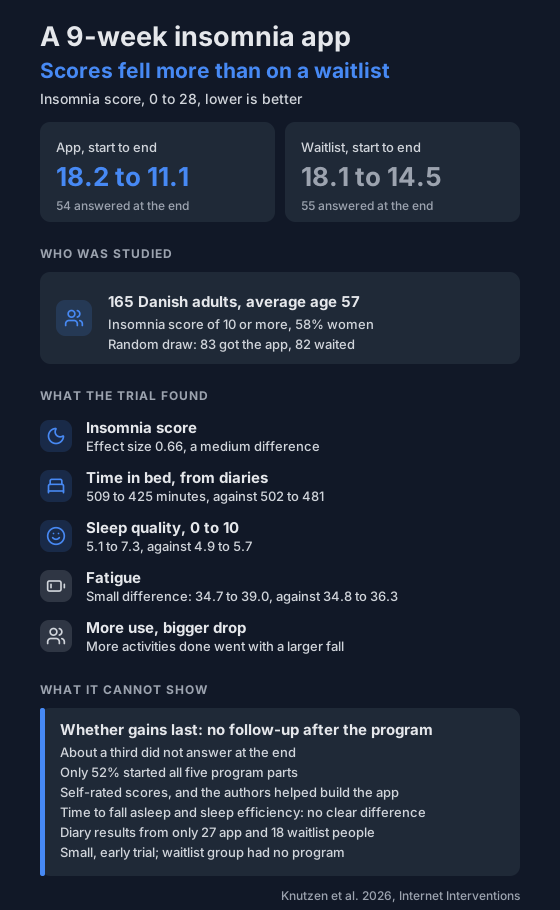
A 2026 trial of 165 Danish adults found insomnia scores fell from 18.2 to 11.1 with a 9-week phone program, against 18.1 to 14.5 on a waitlist. About a third did not answer at the end, and the authors helped build the app.
Apps that offer a structured sleep program are easy to find. Fewer have been tested against a waitlist in a randomised trial. A 2026 trial in Denmark did that for one fully automated program called Hvil.
Insomnia scores fell more with the app than on a waitlist. Many people stopped using it or stopped answering before the end.
What was tested?
- A 9-week program on a phone, with no contact with a therapist.
- It covers the five usual parts of cognitive behavioural therapy for insomnia (CBT-I): limiting time in bed, rules for the bed and bedroom, changing unhelpful thoughts about sleep, relaxation, and sleep habits.
- Time in bed was set to each person's average sleep time, with a floor of 5 hours, and adjusted weekly.
- The waitlist group was encouraged to use the app's sleep diary but got none of the program, then got access after the final questionnaire.
For how this kind of program compares with others, see digital insomnia programs compared.
Who was studied?
- 165 Danish adults after two were removed, 83 given the app and 82 on the waitlist, by random draw.
- They answered an email newsletter sent to members of an insurer-linked group, and scored 10 or more on a standard 0 to 28 insomnia questionnaire.
- Average age was 57, and 58% were women.
- Average insomnia score at the start was about 18 out of 28 in both groups. They had had insomnia for about 7 years on average.
- People with other sleep disorders such as sleep apnea, shift workers and people with conditions affecting sleep were left out. Sleep medicine was allowed.
What did it find?
- Insomnia score (0 to 28, lower is better): the app group went from 18.2 to 11.1 and the waitlist from 18.1 to 14.5, among people who answered at the end. The difference over time was statistically significant (p < .001) in a model that used everyone included. The effect size of 0.66, which the authors call medium, compares end scores of only those who answered.
- Time in bed, from diaries: it fell from 509 to 425 minutes with the app, and from 502 to 481 on the waitlist. This is what the time-in-bed limits aim for.
- Sleep quality, from diaries (0 to 10, higher is better): 5.1 to 7.3 with the app, 4.9 to 5.7 on the waitlist.
- Diary results at the end come from only 27 app and 18 waitlist people.
- Fatigue (0 to 52, higher means less fatigue): 34.7 to 39.0 with the app, 34.8 to 36.3 on the waitlist. The difference over time was statistically significant (p = .004), but the effect size was small, 0.31, and its range crossed zero (-0.07 to 0.69).
- Not clearly different: total sleep time, time to fall asleep, time awake in the night and sleep efficiency. The number of wakings was statistically significant at first, but not after the authors adjusted for testing many outcomes. Sleep efficiency rose in both groups.
- More use went with bigger drops: within the app group, people who did more activities, or started more of the five parts, had larger falls in their score.
- Side effects: two people reported side effects, such as more daytime sleepiness.
- Age, sex, marital status, education and starting score did not significantly change the result.
How many stuck with it?
- 109 of 165 (66%) answered the final questionnaire: 54 in the app group and 55 on the waitlist. Dropout at the end was 35% and 33%.
- In the app group, 43 of 83 (52%) started all five parts. On average people started three.
- Only 45 people (27%) were still filling in the sleep diary in week 9.
- People not in a relationship were about 3 times as likely to drop out of the study, and people with a short education were 6 to 12 times as likely as those with longer education. The ranges were wide.
- The authors did not ask why people left, so some may have stopped because they felt better.
- Neither group nor starting score predicted who dropped out.
- They note that dropout was higher than in earlier trials of fully automated programs.
Because those who left are missing from the end scores, the real gap among everyone who started is uncertain. The authors ran their main analysis on all 165 included, using the data each person did give.
What can't it show?
- It's a small, early trial, run without a planned sample size, and meant to guide a bigger one.
- There was no follow-up after the program, so it cannot say whether the change lasts.
- Scores were self-rated, and no one wore a sleep tracker. Participants knew whether they had the app.
- Two questionnaires, on beliefs about sleep and on stress, were lost to a technical error in the app.
- The study can't say which of the five parts did the work. A recent analysis the authors cite found sleep habits advice added little and relaxation may have worked against remission.
- About a third of people were missing baseline details such as education and sleep medicine use, and the authors say dropout may limit how far the results apply.
- The authors helped develop Hvil with the company that makes it, but say they hold no financial interest in it. The trial was funded by the Danish foundation TrygFonden.
- The waitlist group was encouraged to keep a sleep diary. The authors suggest this may explain why sleep efficiency rose there too.
What can you do with it?
If you track your sleep, the trial gives a few things to compare with your own numbers.
- Note your bedtime, wake time and how long you think you slept. The program's time-in-bed limits worked from exactly these numbers.
- Watch whether your own time in bed and sleep quality score move together over several weeks.
- A trend in your own log shows what changed, not why.
Any change to your time in bed or your sleep medicine is worth discussing with a clinician first.
Not a medical device. Does not diagnose, treat or prevent any condition. Discuss results and changes with a clinician.
References
- Knutzen SM, Christensen DS, Neumann H, Damholdt MF, Amidi A, Zachariae R. Smartphone-delivered cognitive behavioral therapy for insomnia: A preliminary randomized controlled trial. Internet Interventions. 2026;46:101007. doi:10.1016/j.invent.2026.101007