Apple Watch SpO2 Over Months: One Man's Case
A 2026 case report: one man's monthly average Apple Watch SpO2 fell from 95.7% to 94.4% as his lung disease got worse, then rose to 96.5% four weeks into steroid therapy.
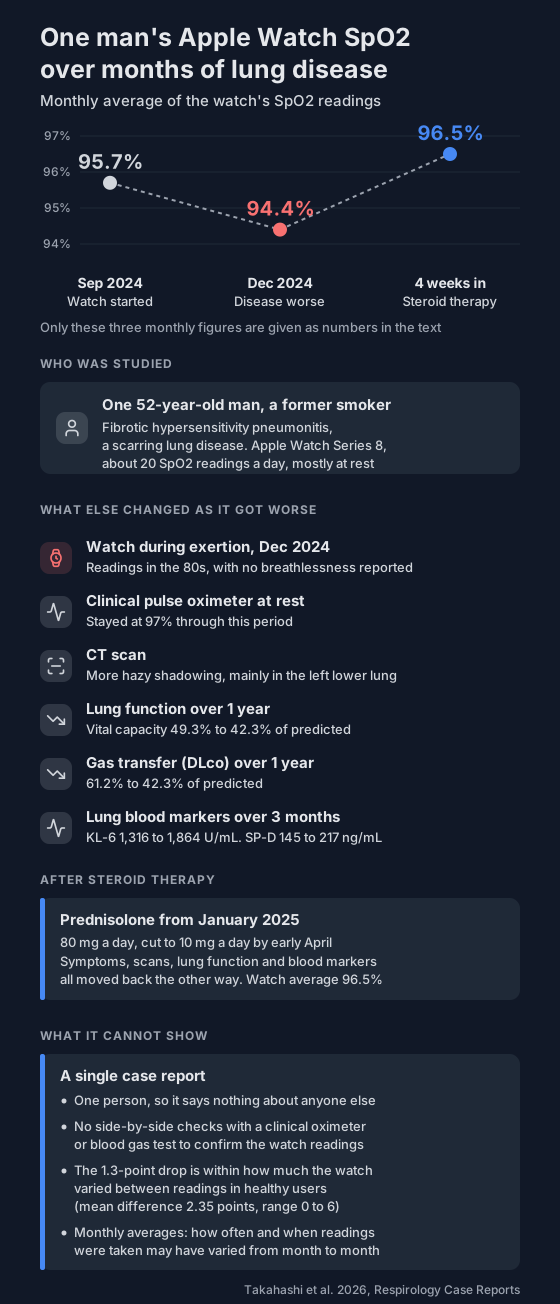
Most talk about watch SpO2 is about single readings. A case report published in July 2026 looks at the other end: months of readings from one man's Apple Watch while his lung disease got worse and then responded to steroid therapy.
It's one person, so read it as a story, not evidence that a watch can follow lung disease.
Who was the patient?
- A 52-year-old man, a former smoker.
- He had fibrotic hypersensitivity pneumonitis, a lung disease where inflammation leads to scarring.
- He'd had a cough since 2010, and it got worse in 2020.
- He wore an Apple Watch Series 8 from September 2024.
- It took about 20 SpO2 readings a day, mostly while he was resting, day and night.
What did the watch show?
The authors took a monthly average of the watch's readings:
- September 2024: 95.7%.
- December 2024: 94.4%, as his lungs got worse.
- 4 weeks after starting steroids: 96.5%.
In December the watch also showed readings in the 80s during exertion. He didn't report feeling breathless. His resting SpO2 on a clinical pulse oximeter stayed at 97% through the same period.
What else changed?
The watch trend lined up with the hospital tests:
- CT scan: more hazy shadowing, mainly in the left lower lung.
- Vital capacity: 49.3% to 42.3% of the predicted value, over a year.
- Gas transfer (DLco): 61.2% to 42.3% of predicted, over a year.
- Blood markers of lung damage: KL-6 rose from 1,316 to 1,864 U/mL and SP-D from 145 to 217 ng/mL over 3 months.
Tests found no infection, heart failure, blood clot or autoimmune disease to explain it.
What happened after steroid therapy?
He was admitted in January 2025 and started prednisolone at 80 mg a day. The dose was cut to 10 mg a day by early April. The paper reports that his low oxygen on exertion, his scans, lung function and blood markers all got better. The watch's monthly average went up to 96.5%.
The authors' point is that the trend over months matched the other tests, not that any one reading did.
What doesn't it tell you?
The authors list the limits themselves:
- It's one person. Nothing here says what would happen for anyone else.
- The watch readings weren't checked. There were no side-by-side readings with a clinical oximeter or a blood gas test.
- The drop is small. 1.3 points sits within how much Apple Watch readings varied in healthy users in an earlier study (a mean difference of 2.35 points, range 0 to 6).
- Averages hide detail. How often and when readings were taken may have varied from month to month.
They also say smartwatch SpO2 is built for wellness and hasn't been validated for medical decisions. Low readings that matter should be confirmed on clinical equipment.
For how close watch readings get to a fingertip oximeter, see the Apple Watch accuracy review and smartwatch vs pulse oximeter.
What can you take from this?
- Look at averages over weeks and months, not one number.
- Note what you were doing when a low reading came up: resting, walking, asleep.
- Keep measuring the same way so months can be compared.
If you have a lung condition and your numbers drift, share them with your doctor. What they mean and what to do about it is their call.
Not a medical device. Does not diagnose, treat or prevent any condition. Discuss results and changes with a clinician.
References
- Takahashi T, Saito A, Koyama M, Hirota K, Ohnishi H, Chiba H. Smartwatch-Derived SpO2 Trends During Disease Worsening and Treatment Response in Fibrotic Hypersensitivity Pneumonitis: A Case Report. Respirology Case Reports. 2026;14(7):e70670. doi:10.1002/rcr2.70670