Altitude, Sleep Length and Mood in China
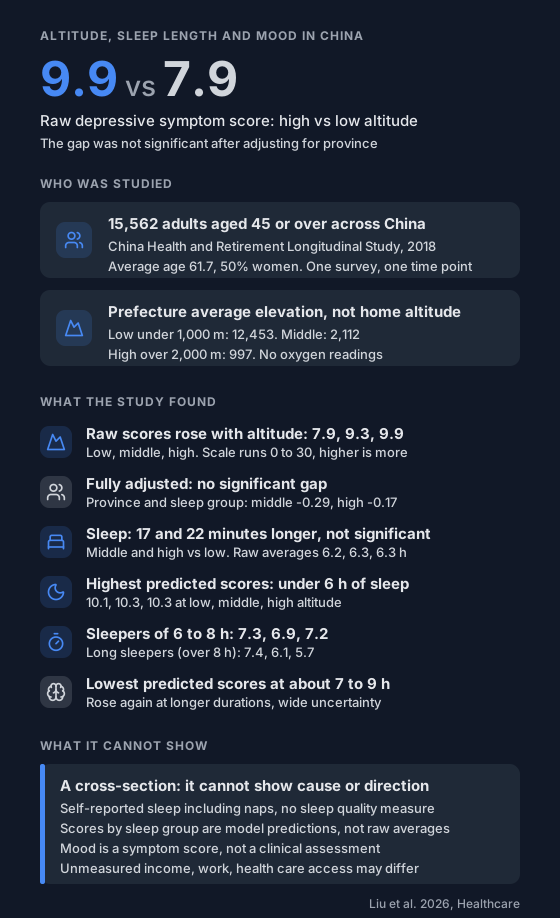
In 15,562 adults aged 45 or over across China, higher-altitude areas had higher depressive symptom scores at first, but the gap was not significant after adjusting for province. Short sleepers had the highest predicted scores at every altitude.
People who live high up are often said to sleep worse and feel lower. A 2026 study in China looked at whether that shows up in a national survey of adults aged 45 or over.
Its main question was whether the area a person lives in, by elevation, lines up with their depressive symptom score and how long they sleep.
Who was studied?
- 15,562 adults aged 45 or over, from a national survey of China (CHARLS, 2018).
- Average age 61.7, and 50% were women.
- Each person was given the average elevation of their prefecture, not the height of their own home.
- 12,453 lived in low areas (under 1,000 m), 2,112 in middle (1,000 to 2,000 m) and 997 in high (over 2,000 m).
Depressive symptoms came from a 10-question checklist scored 0 to 30, where a higher score means more symptoms. Sleep was the total hours a person reported per day, naps included. Nobody wore an oximeter, so there were no oxygen readings.
Did higher altitude go with more depressive symptoms?
At first, yes. Average scores were 7.9 at low, 9.3 at middle and 9.9 at high altitude.
The gap stayed after the authors adjusted for personal factors such as age, education and health habits. Once they also adjusted for province, the differences were no longer statistically significant. With province and sleep group both in the model, middle was 0.29 points below low and high was 0.17 below, with p values of 0.57 and 0.75.
The authors say altitude in China overlaps with other regional differences, such as health care access, education, work and social support. They write that the findings do not support altitude as an independent cause of depressive symptoms. They also say this is not proof that altitude plays no part.
Did people at altitude sleep more or less?
A little more, but the difference was not statistically significant. Raw averages were 6.2, 6.3 and 6.3 hours. After adjustment, middle altitude was 0.28 hours (about 17 minutes) longer than low and high altitude was 0.36 hours (about 22 minutes) longer. The confidence intervals for both included zero, with p values of 0.060 and 0.130. The paper's abstract and conclusions still describe this as longer sleep, so we're going by the results section.
The authors point out that hours slept are not sleep quality. They list breathing during sleep and oxygen levels as things this study did not measure. For what oximeters do record at height, see blood oxygen at altitude.
What did sleep length show?
Short sleepers had the highest predicted scores at every altitude. These are the study's adjusted model predictions, not raw averages:
- Under 6 hours: 10.1 at low, 10.3 at middle, 10.3 at high altitude.
- 6 to 8 hours: 7.3, 6.9 and 7.2.
- Over 8 hours: 7.4, 6.1 and 5.7.
The altitude pattern differed between sleep groups, and that difference was statistically significant. The significant part was in long sleepers, while the terms for 6 to 8 hours were not significant. Across all altitudes, predicted scores were lowest at roughly 7 to 9 hours of sleep and rose again at longer durations, with wide uncertainty at the top end. The authors warn that long sleep can reflect illness or low activity, so the lower scores in long sleepers at altitude are not a sign that more sleep helps.
What can't it show?
- Cause or direction. It's a cross-section, one survey at one time. Short sleep could lower mood, low mood could shorten sleep, or something else could drive both.
- Home altitude. Elevation was an area average, so a person's own height was not known.
- Sleep quality. Hours were self-reported and included naps. There was no sleep tracker, oximeter or breathing measure.
- Clinical assessment. The score counts symptoms and is not a clinical assessment of depression.
- Other factors. Income, work, medication, air pollution and social support were not measured.
- Small groups. Only 997 people lived in high areas and 114 of them were long sleepers. The survey weights were not used, so the results are not national estimates.
The authors say studies that follow people over time, with each person's own altitude and objective sleep measures, are needed.
What can you take from it?
- A raw gap between regions can come from other differences between those regions.
- This study can't say whether a given person's altitude affects their mood or sleep.
- If you track your own sleep and overnight oxygen, how many nights to record covers how much data gives a steady picture.
- If low mood or short sleep is a regular problem, raise it with your doctor.
Not a medical device. Does not diagnose, treat or prevent any condition. Discuss results and changes with a clinician.
References
- Liu Z, Chen C, Shi C, Gao Y, Li Y, Xu X, Li H, Xia S, Li S, Liu J. Prefecture-Level Mean Elevation, Sleep Duration, and Depressive Symptoms Among Middle-Aged and Older Adults in China: A Cross-Sectional CHARLS Study. Healthcare (Basel). 2026;14(20):3544. doi:10.3390/healthcare14203544