COPD, Altitude and Night Oxygen: A 2026 Paper
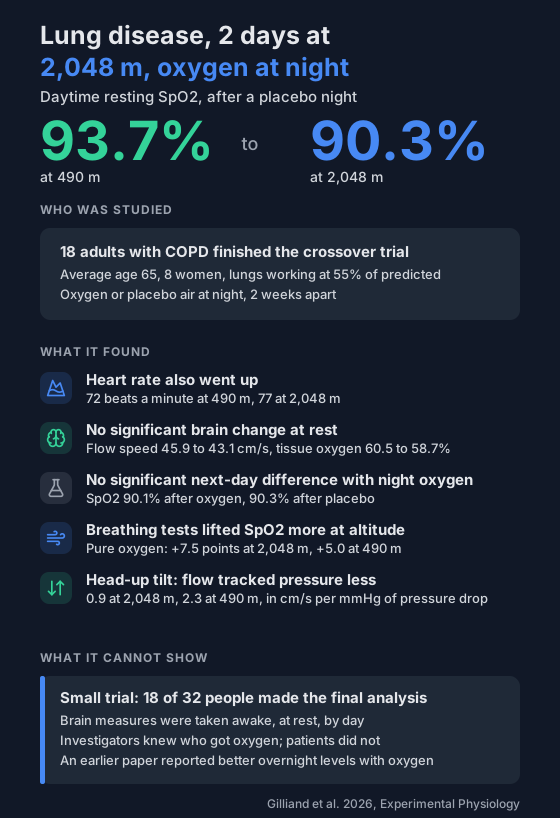
A 2026 paper on 18 adults with COPD: two days at 2,048 m lowered daytime SpO2, brain blood flow speed showed no significant change, and night oxygen made no significant next-day difference.
Altitude can be a challenge for people with COPD, because their breathing has less in reserve. An earlier paper from this same trial found lower brain oxygen during sleep at 2,048 m than at 490 m, and better overnight brain oxygen with oxygen than with placebo. This paper asks a different question: what is the brain doing the next day, awake and at rest? It appeared online in July 2025 and in the February 2026 issue, but the trial is older, as those night-time results came out in 2020.
Who took part?
- 32 adults with COPD were randomised.
- 18 finished and were analysed: 8 women and 10 men, average age 65.
- Their lungs worked at 55% of the predicted level on average (FEV1), and entry required 30% to 80%.
- Everyone lived below 800 m and had an SpO2 of 92% or more at 490 m.
- 14 were left out of the analysis. Ten of them (31% of those randomised) had an altitude-related problem at 2,048 m, and four had technical failures.
What did the trial do?
- It was a crossover trial at the University Hospital of Zurich (490 m) and St Moritz (2,048 m).
- Each person spent two days and two nights at 2,048 m twice, with two weeks between stays.
- One stay, picked at random, had 3 litres a minute of oxygen through nasal tubing at night, and the other had placebo air. Patients did not know which was which.
- On the second day, in the morning, the team measured SpO2, brain tissue oxygen (near-infrared light), blood pressure and the speed of blood flow in a brain artery (ultrasound).
- The same tests were done at 490 m.
- The tests were quiet breathing, breathing pure oxygen, deliberate fast breathing with and without pure oxygen, and a tilt from lying flat to 60 degrees head-up.
What happened to SpO2 and the heart?
- Resting SpO2 averaged 93.7% at 490 m and 90.3% at 2,048 m after a placebo night.
- After a night on oxygen it was 90.1%. The oxygen minus placebo difference was -0.2 points (95% confidence interval -1.1 to 0.6, p = 0.613), which was not statistically significant.
- Median resting heart rate went from 72 to 77 beats a minute after placebo, and 77 after oxygen.
- The fall in SpO2 and the rise in heart rate at 2,048 m were both statistically significant.
What happened in the brain?
At rest, breathing room air, no brain measure showed a statistically significant change between 490 m and 2,048 m.
- Median blood flow speed: 45.9 cm/s at 490 m, 43.1 cm/s at 2,048 m after placebo, 43.3 after oxygen.
- Average brain tissue oxygen: 60.5% at 490 m, 58.7% after placebo, 59.0% after oxygen.
- Average mean blood pressure: 94 mmHg at 490 m, 97 after placebo, 94 after oxygen.
The authors read this as the brain's blood supply and oxygen being maintained at rest during the day, despite the lower SpO2.
Did oxygen at night change the next day?
Not in any way the trial could show. Across the resting readings, the breathing tests and the tilt, there was no statistically significant difference between the oxygen stay and the placebo stay. Because of that, the authors pooled the two stays for the breathing and tilt tests.
The night-time results from this trial came out earlier, in a 2020 paper by Tan and colleagues. As this paper describes them, oxygen at night brought better overnight blood and brain oxygen than placebo, steadier breathing, better self-rated sleep and fewer altitude-related illnesses. On placebo nights at 2,048 m, brain oxygen was lower and brain low-oxygen events more frequent than at 490 m. This paper only adds the next-day measurements.
What about the breathing and tilt tests?
- Breathing pure oxygen raised SpO2 by 7.5 points at 2,048 m and by 5.0 at 490 m. Deliberate fast breathing with room air raised it by 6.6 against 4.3, and fast breathing on oxygen by 8.6 against 5.4. All three rises were significantly larger at 2,048 m.
- Brain blood flow and tissue oxygen changed in a similar way at both heights.
- On the tilt, blood pressure fell by 14 mmHg at 2,048 m and 10 mmHg at 490 m, and flow speed fell by 15.8 and 13.3 cm/s. Neither gap was statistically significant.
- Flow speed fell less per mmHg of pressure drop at 2,048 m: 0.9 against 2.3 cm/s (p = 0.007). The authors read a smaller drop as tighter and better control of brain blood flow.
What can't it tell you?
- Small effects. Only 18 finished, and only people who completed the tests were analysed. The authors did no sample size calculation for this part and put the smallest effect size it could pick up at 0.67, so smaller effects could be missed.
- Who dropped out. The people who had a problem at altitude, such as very low SpO2 or a flare-up, are not in the analysis.
- Night and exercise. The brain measures were taken awake, at rest or during the short breathing and tilt tests. The authors point to earlier work showing low brain oxygen during sleep and during exercise at this height.
- Blinding. Patients did not know which night they got, but the investigators did, because they monitored night-time SpO2 for safety.
- Measurement. Ultrasound speed stands in for blood flow and assumes the artery stays the same width. The authors did not measure nerve activity that can change vessel width, and the tilt results were not corrected for CO2.
- Everyone with COPD. The group was aged 18 to 75, lived at low altitude and had SpO2 of 92% or more at 490 m. Nobody used routine oxygen, CPAP or bilevel machines.
The authors declared no conflicts of interest. Siemens Health Engineers provided some equipment.
What can you do with this?
In this trial the average resting SpO2 after a placebo night was 3.4 points lower at 2,048 m than at 490 m. You can see your own pattern in the session viewer, and share the readings with your doctor. For more on what altitude does to the number, read blood oxygen at altitude.
Not a medical device. Does not diagnose, treat or prevent any condition. Discuss results and changes with a clinician.
References
- Gilliand D, Latshang TD, Aeschbacher SS, Huber F, Flueck D, Lichtblau M, Ulrich S, Hasler ED, Scheiwiller PM, Müller J, Ulrich S, Bloch KE, Furian M. Effect of moderate altitude and nocturnal oxygen therapy on cerebrovascular function in patients with COPD: A randomized, crossover trial at 2048 m. Experimental Physiology. 2026;111(2):527-538. doi:10.1113/EP093003