Sleep Apnea at Altitude: One Man's Case
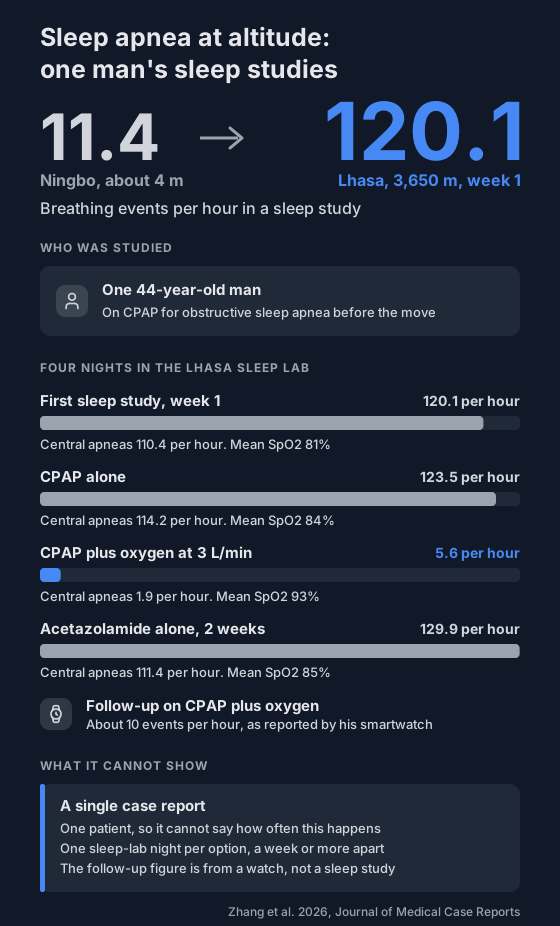
A 2026 case report: a man with 11.4 breathing events per hour near sea level had 120.1 per hour a week after moving to Lhasa at 3,650 m, almost all central apneas.
Blood oxygen runs lower at altitude, and breathing during sleep gets less steady. A case report published in March 2026 describes one man whose sleep apnea changed type after he moved to Lhasa, at 3,650 m.
It's one patient, so read it as a story, not a rule.
Who was the patient?
- A 44-year-old office worker who had snored for 10 years.
- A sleep study in Ningbo, at about 4 m, counted 11.4 breathing events per hour.
- They were mostly obstructive, meaning the airway narrows or closes.
- His lowest SpO2 that night was 81%.
- He started CPAP and his night-time symptoms and dry mouth eased.
What happened at altitude?
He moved to Lhasa for work and kept using CPAP. Within a week the dry mouth was back, with unrefreshing sleep and fatigue.
A sleep study there counted:
- 120.1 breathing events per hour.
- 110.4 of them were central apneas, where the airway is open but the drive to breathe pauses.
- An ODI of 129.2 per hour.
- A mean SpO2 of 81%.
What did the doctors try?
Each option got one night in the sleep lab.
- CPAP alone: 123.5 events per hour, mean SpO2 84%.
- CPAP plus oxygen at 3 L/min: 5.6 events per hour, mean SpO2 93%, ODI 10.7.
- Acetazolamide alone for 2 weeks: 129.9 events per hour, mean SpO2 85%, and he reported diarrhea and limb numbness.
He found CPAP plus oxygen awkward when he went out, which is why the drug was tried. He then went back to CPAP plus oxygen. After that his smartwatch reported about 10 events per hour, and he said he felt fine during the day.
The authors point out that earlier studies found CPAP and acetazolamide lowered these events in other people at altitude. This man's counts didn't fall with either one alone. They also note oxygen therapy isn't recommended for long-term use.
What doesn't it tell you?
- How common this is. One patient can't show that.
- What works for anyone else. There was one night per option, a week or more apart, in one man.
- The long-term picture. The follow-up figure came from a smartwatch, not a sleep study.
- Every detail. A few figures in the paper's discussion don't match its results section, so the numbers here are from the results.
What can you do with this?
If you have sleep apnea and plan to stay at altitude, talk to your doctor before you go. Which therapy suits you up there is their call.
An overnight oximeter can't tell obstructive events from central ones. On CPAP? See tracking your oxygen alongside CPAP.
Not a medical device. Does not diagnose, treat or prevent any condition. Discuss results and changes with a clinician.
References
- Zhang Y, Wang H, Liu S, Feng G, Chi Z, Zhang P, Zhang N. Emergence of central sleep apnea at high altitude in patients with mild obstructive sleep apnea: a case report. Journal of Medical Case Reports. 2026;20(1):238. doi:10.1186/s13256-026-05982-4