Sleep Apnea in Pregnancy and the Baby
A 2026 review of 64 publications found the link between sleep apnea in pregnancy and the baby's outcomes depends on how it was measured. Sleep test studies were mixed. Hospital-code studies more often linked it with preterm birth.
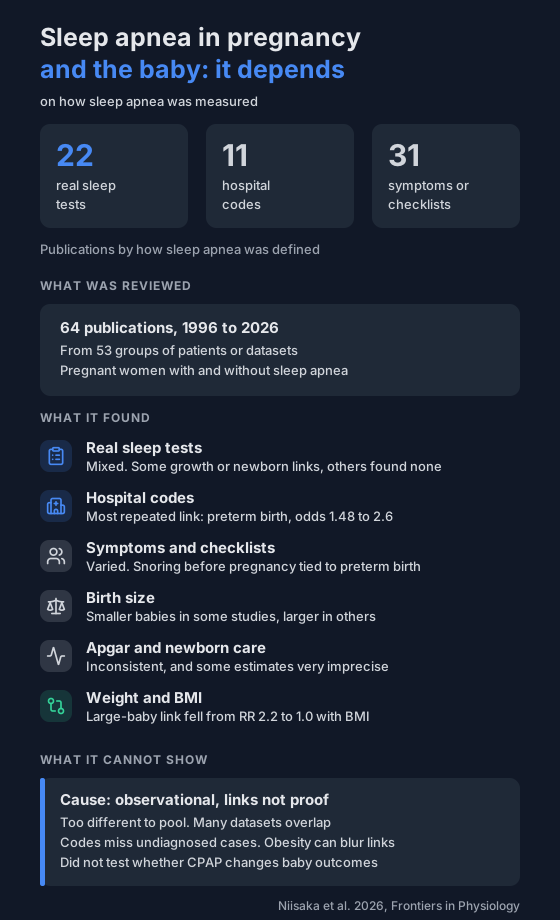
Snoring and sleep apnea can start or get worse during pregnancy. So researchers have asked whether it shows up in the baby's outcomes, like birth weight and preterm birth.
A 2026 review pulled together 64 publications on this. Its main point is that the answer changes with how sleep apnea was measured.
What did the review do?
- It searched for studies comparing pregnant women with and without sleep-disordered breathing.
- The included studies were published from 1996 to 2026.
- 64 publications were included. They came from 53 groups of patients or datasets.
- It sorted them by how sleep apnea was defined, because the groups aren't the same thing.
- It looked at birth weight and length, growth in the womb, preterm birth, Apgar scores and newborn care.
- It did not pool the numbers. The studies were too different.
How did the three groups compare?
| How sleep apnea was defined | Publications | What the review found |
|---|---|---|
| Sleep tests, like a sleep study, home test or overnight oximetry | 22 | Mixed. Some links with growth or newborn outcomes, and several studies found none. |
| Hospital or medical record codes | 11 | The most repeated link was with preterm birth. |
| Symptoms, snoring or checklists | 31 | Varied by the symptom, the timing and the outcome. |
What did the sleep test studies show?
- A few found links with slower growth in the womb. One study, limited to pregnancies with predicted fetal weight below the 75th centile, found higher odds of a small baby at 10 or more breathing events per hour (odds ratio 2.65).
- Others went the other way. One found higher birth weight with more oxygen dips, and one found a link with larger babies.
- Several found no clear difference. One reported birth weight of 3.25 kg with sleep apnea against 3.21 kg without.
- In one large cohort, an early-pregnancy link with large babies was risk ratio 2.2 before adjusting for BMI and 1.0 after.
- Some of the positive estimates were very imprecise. One study of low Apgar scores had a confidence interval from 1.17 to 289.
What about hospital codes and symptoms?
- Coded sleep apnea was linked with preterm birth in four studies, with adjusted odds from 1.48 to 2.6.
- Some coded studies drew on overlapping datasets, so they aren't four independent results.
- In California data, coded sleep apnea was linked with birth before 37 weeks (odds ratio 1.5) and more strongly before 34 weeks (2.2).
- Some symptom studies found links with preterm birth too. Gasping had odds of 1.8, and snoring before pregnancy had 2.75.
- Snoring that began during pregnancy was not linked with preterm birth in the same study.
- Birth size and Apgar results in these groups were mixed.
Why do the results differ?
- Different things are measured. A hospital code means sleep apnea was recorded in someone's notes. A snoring question measures symptoms or risk, not confirmed sleep apnea.
- Codes miss people. Undiagnosed sleep apnea isn't in the records, and the codes say little about timing or how many events per hour.
- Weight matters. Obesity is linked with both sleep apnea and pregnancy outcomes, and it can blur the link.
- Datasets overlap. Several large coded studies drew on the same national or state data, so they aren't independent repeats.
- Small samples. Several sleep test studies were small or picked from higher-risk groups.
What can't this review tell you?
- Cause. These are observational studies. The review says the links shouldn't be read as cause and effect.
- Whether therapy changes outcomes. It did not look at whether CPAP changes the baby's outcomes.
- Whether everyone should be tested. It did not assess testing for everyone in pregnancy.
- A clean result. The authors rate the evidence as limited. Their search skipped Embase and was limited to English.
- Planning. The review was registered after it had started, so the authors don't call it prospectively registered.
What can you do with it?
These are links across groups of pregnancies, not a forecast for any one of them. If you snore, wake gasping or feel unrested in pregnancy, mention it to your midwife or doctor. Overnight oxygen data can be part of that conversation, and here's how to share it.
For the classic signs, see snoring vs sleep apnea.
Not a medical device. Does not diagnose, treat or prevent any condition. Discuss results and changes with a clinician.
References
- Niisaka M, Hosomichi J, Mitsuishi S, Kino S, Ono T. Fetal and neonatal outcomes of pregnancies complicated by maternal sleep-disordered breathing: a systematic review. Frontiers in Physiology. 2026;17:1775697. doi:10.3389/fphys.2026.1775697