Radiant Cooling vs Air Con: Sleep Trial
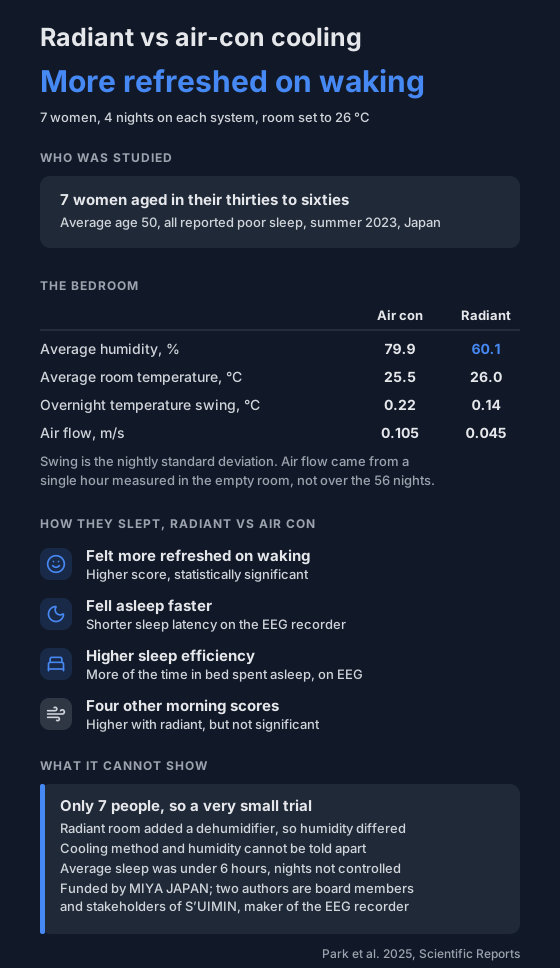
A 2025 crossover trial put 7 women in a bedroom set to 26 °C, cooled by a ceiling radiant system and by an ordinary air conditioner. They felt more refreshed after the radiant nights, and EEG showed faster sleep onset.
Most people judge a bedroom by its temperature. This trial set the same target temperature and changed how the room was cooled.
It's a 2025 crossover trial from Japan, and it was tiny: 7 women. Read it as an early signal, not a finding to build on.
How did the trial work?
- Who. 7 healthy women in their thirties to sixties. Average age 50, average BMI 22.
- Why them. All reported poor sleep on a questionnaire (Athens Insomnia Scale of 6 or more), but not daytime sleepiness.
- What. Each woman slept 4 nights in a test bedroom with ordinary air conditioning, then 4 nights with radiant cooling, or the other way round. A 3-day gap separated the two blocks.
- Radiant cooling. Water at 18 °C ran through tubing on the ceiling. The room is cooled by radiation from that surface, without a fan blowing air.
- Air con. An ordinary air conditioner that cools and dries the air with a fan.
- Same target. Both were set to 26 °C near the bed.
- Blinding. The women weren't told which system was running.
- Measures. A portable EEG recorder for sleep, and a morning questionnaire (the OSA-MA sleep inventory) for how they felt.
It ran from late July to the start of September 2023. The women kept their usual routines, including work and their usual bed and wake times.
What was different in the room?
The air temperature wasn't identical, and humidity was far apart.
| Over 56 nights | Air con | Radiant |
|---|---|---|
| Average temperature | 25.5 °C | 26.0 °C |
| Temperature swing within a night (SD) | 0.22 °C | 0.14 °C |
| Average relative humidity | 79.9% | 60.1% |
All three differences were statistically significant. The swing in humidity within a night (1.9% against 2.1%) was not significantly different. The radiant room was slightly warmer on average and held steadier.
The authors also measured the empty room for one hour per system. That was a single run with no statistics. Air flow was 0.045 m/s with radiant cooling against 0.105 m/s with air con.
What did they find about sleep?
- Morning feeling. The sleep inventory has five scores. Only "refreshing" was significantly higher after radiant nights. The other four were also higher with radiant, but not significantly.
- Falling asleep. Sleep latency, the time taken to fall asleep, was shorter with radiant cooling.
- Sleep efficiency. The share of time in bed spent asleep was higher with radiant cooling.
The paper shows the EEG results in a chart, not in the text, so this article gives direction only. The paper reports only these two EEG measures as significantly different.
Recordings from 3 of the 56 nights were incomplete and left out of the EEG analysis.
Was it the cooling method or the humidity?
The trial can't say, and the authors say so.
The radiant room used a separate dehumidifier to stop moisture forming on the ceiling tubing. The air con unit's drying appeared to switch off whenever its cooling cycled off, which the authors say at least partly explains the higher humidity. That left the air con nights about 20 percentage points more humid.
So the comparison is "radiant plus steady dehumidifying" against "ordinary air con". The authors suggest a follow-up that fits the same dehumidifier to an ordinary air conditioner.
Their ideas for why radiant might help are lower humidity, steadier temperature and less air movement. Those are suggestions, and the trial didn't test them.
Who paid for it?
Check this before you weigh the result.
- The study was funded by MIYA JAPAN Co. Ltd. Four of the authors work there. The paper doesn't say whose radiant system was used.
- It also had public grants from Japanese research agencies, which went to one author.
- The EEG recorder is made by S'UIMIN Inc. Six authors list an affiliation with S'UIMIN, two of them with University of Tsukuba too.
- Two authors are board members and stakeholders of S'UIMIN, and a third received an honorarium from it.
- The conflict of interest statement lists nothing for MIYA JAPAN.
- The paper says the sponsors played no role in analysing the data or preparing the manuscript.
- Authors from MIYA JAPAN and S'UIMIN helped conceive the study and ran the experiment.
What can't it show?
- Much, with 7 people. Results from a group this small can swing either way. The women also all reported poor sleep, so they may not look like most sleepers.
- Why. Cooling method and humidity moved together.
- Long-term effects. It covers 4 nights per system, in summer, in one test room.
- Short sleep. Bed and wake times weren't set, and average sleep time was under 6 hours.
- Winter. Heating wasn't tested.
- Other temperatures. Everything was at about 26 °C.
What can you do with this?
Not much yet, and the trial doesn't recommend a purchase. The takeaway is that room temperature alone may not describe how a bedroom feels. Humidity and air movement also changed here.
If you log your nights, note the temperature and humidity of your room next to how you slept. For another look at warm bedrooms, see bedroom temperature and heart rate variability.
Not a medical device. Does not diagnose, treat or prevent any condition. Discuss results and changes with a clinician.
References
- Park I, Cui Y, Kawana F, Tominaga M, Miyamura R, Yamagishi H, Okado M, Miyamura M, Nakamura S, Tanigawa C, Kokubo T, Yanagisawa M, Tokuyama K. Subjective and objective quality of sleep with radiant or convection cooling systems: a randomized, cross-over trial. Scientific Reports. 2025;15(1):35119. doi:10.1038/s41598-025-19163-8