Philips CPAP Recall: What Users Went Through
Researchers interviewed 47 people in Canada about the 2021 Philips CPAP recall. They described poor information, slow replacements, hard choices about therapy and lost trust.
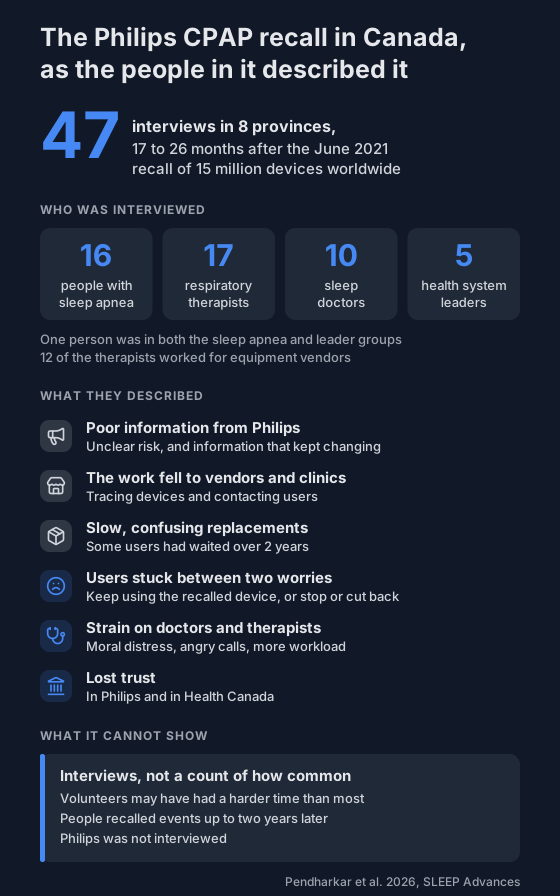
In June 2021 Philips recalled nearly all models of its CPAP and other PAP machines and ventilators made before April 26, 2021. About 15 million devices worldwide were affected, because the sound-dampening foam inside could break down.
Surveys have counted how many people stopped or cut back on their machines. A 2026 study from Canada asked the people involved what it was actually like.
Who did they talk to?
- 47 people from 8 Canadian provinces, interviewed between November 2022 and August 2023.
- 16 adults with sleep apnea, all of whom had used a recalled device.
- 17 respiratory therapists: 12 at equipment vendors, 4 in the public sector and 1 in both.
- 10 sleep doctors and 5 health system leaders.
- One person counted as both a patient and a leader, which is why the groups add up to 48.
- Health Canada declined an interview but answered questions in writing.
- Philips wasn't invited. The authors wanted to focus on people receiving, giving and regulating care, and worried interviewees would hold back.
What went wrong with the information?
- Most people were taken by surprise.
- Everyone described Philips' communication as poor.
- One sleep doctor said they weren't told how common the problem was, what the health effects could be or when replacements would come.
- Users found the recall website confusing, and some got US information that didn't apply in Canada.
- One vendor therapist said Philips changed the story about three times, so what they told patients kept changing too.
- Many felt the messages were shaped by legal concerns, not by patients' needs.
- Guidance from Canadian medical societies helped fill the gap.
Who did the legwork?
Mostly vendors and sleep clinics.
- Vendors pulled sales records and wrote to or phoned customers with recalled machines.
- One small vendor phoned people for three weeks, still had about 500 to call a month later, and switched to letters.
- Some users said they were never notified by their vendor or clinic.
- Replacements came through vendors, not straight from Philips, which confused people.
- Some machines were swapped whole and others only had parts replaced, and one vendor said there was no pattern to which got which.
- At the time of the interviews, some users had been waiting over 2 years.
What was it like for people on CPAP?
The hardest part was a choice with no clear answer.
- Keep using a recalled machine and worry about the foam, cancer above all.
- Or stop or cut back, and worry about going without therapy.
- Many who stopped or cut back described worse sleep, worse days and lower quality of life.
- Some paid for a new machine rather than wait. Many couldn't afford to.
- People in rural areas drove long distances, sometimes with a hotel stay, to see a vendor or specialist.
- One person said they'd spent about 20 hours on calls and emails and were no further ahead.
- A small minority weren't worried and saw the recall as a precaution.
On CPAP? Here's how to track your oxygen alongside it.
And for the people giving care?
- One sleep doctor said 15 of 35 patients in a clinic day came in about the recall.
- Doctors and therapists described moral distress: they had a possibly harmful device to offer and no alternative.
- Many considered leaving their profession, the authors report.
- Vendor staff felt caught in the middle and took the anger, including verbal abuse and bad online reviews.
- Vendors described extra workload and financial strain. At one, a secretary quit.
What happened to trust?
- Participants described lost trust in Philips and in Health Canada.
- Many users switched or planned to switch brands.
- Clinicians and vendors were reluctant to stock or recommend Philips devices.
- Many said it wasn't just the foam: it was the disorganised response.
- Health Canada wrote that its own actions met the regulations, and that Philips had so far provided the information one section of the regulations required, with the rest due when the recall was complete.
- Participants said the regulations themselves needed to change.
- A few felt the recall showed the system working: a problem was found and acted on.
The authors suggest a central device registry, recall alerts built into connected machines, and set timelines for fixing recalled devices.
What can't this study show?
- How common each experience was. It's 47 interviews, not a survey.
- A balanced picture. People who had a harder time may have been more likely to volunteer.
- Exact memories. The interviews took place 17 to 26 months after the announcement.
- Philips' side. The company wasn't interviewed.
- Everywhere. Care and funding differ between provinces, and some groups were small, which the authors say may limit how far the findings carry.
The study was funded by the Canadian Institutes of Health Research. Outside this work, some authors reported ties to ResMed and Fisher & Paykel, which also make CPAP machines.
What can you do with this?
If you have questions about your machine, talk to your vendor or your doctor. If you track your nights with an oximeter, you can share the data with your doctor.
Not a medical device. Does not diagnose, treat or prevent any condition. Discuss results and changes with a clinician.
References
- Pendharkar SR, Blades KG, Yazji B, Ayas NT, Owens RL, Kaminska M, Mackenzie C, Gershon AS, Ratycz DC, Lishchenko V, Fenton ME, McBrien KA, Povitz M, Kendzerska T. Exploring the impact of a medical device recall on individuals with obstructive sleep apnea and healthcare providers: a qualitative study. SLEEP Advances. 2026;7(3):zpag077. doi:10.1093/sleepadvances/zpag077