Oxygen Overshoot After a Dip: 2026 Commentary
After an oxygen dip, your reading can climb above your usual level. A 2026 commentary looks at a study linking this overshoot to heart events, and says what it can and can't show.
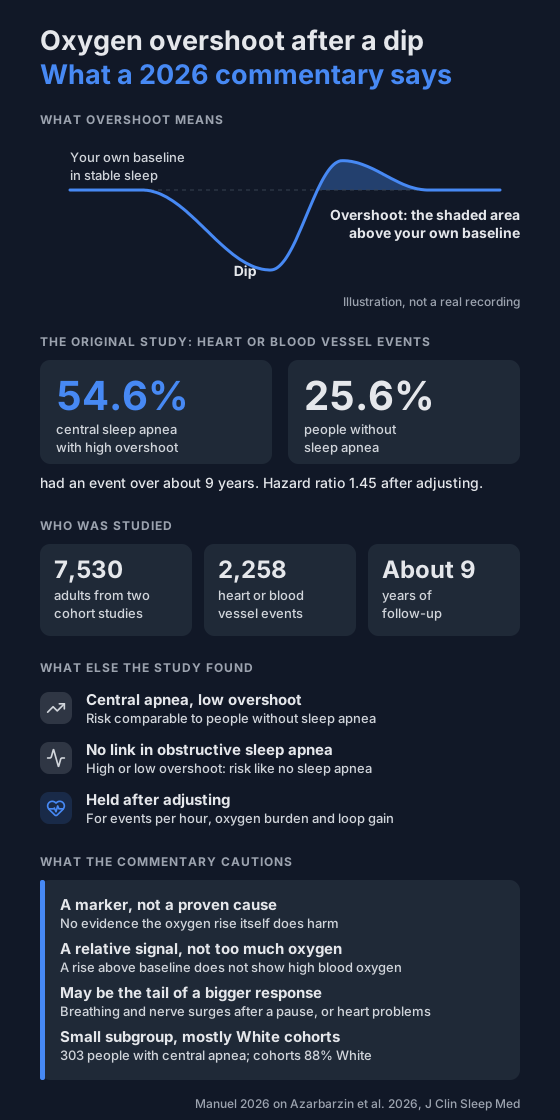
Most oxygen research looks at the dips: how deep they go and how long they last. But after a dip, your reading often climbs back past where it started before it settles. That rise above your own baseline is called oxygen overshoot.
A 2026 study put a number on it and linked it to heart events. This article covers a short commentary on that study, written by a UK respiratory doctor and published in the same journal.
What is oxygen overshoot?
- The study took your baseline as your oxygen level during stable sleep.
- Overshoot burden is the total area of the trace above that baseline, adjusted for how long you slept.
- It's the mirror image of oxygen burden, which adds up the area below.
Cheyne-Stokes breathing, a waxing and waning pattern, produces it: oxygen falls, recovers and can rise above the baseline.
What did the original study find?
These are the numbers the commentary quotes from the study:
- 7,530 people from two cohorts, the Sleep Heart Health Study and the Osteoporotic Fractures in Men Study.
- Over nearly nine years, there were 2,258 major heart or blood vessel events.
- Among people with central sleep apnea and high overshoot, 54.6% had an event, against 25.6% of people without sleep apnea.
- After adjusting for other factors, that was a hazard ratio of 1.45 (95% CI 1.16 to 1.82, from the study's abstract).
- Central sleep apnea with low overshoot had risk comparable to people without sleep apnea.
- In obstructive sleep apnea, overshoot showed no link: high and low overshoot both had risk comparable to people without sleep apnea.
- Across everyone, more overshoot went with higher risk, and the link was stronger in people with any central pauses (study abstract).
- The link held after adjusting for events per hour, central pauses per hour and oxygen burden, and for loop gain in one of the cohorts.
Loop gain is how jumpy your breathing control is.
What does the commentary caution?
It's a marker, not a proven cause. The study was observational: it shows a link, not that the overshoot does harm.
It's not proof of too much oxygen. A reading above your own baseline doesn't show that your blood or tissues got more oxygen than they should. The study measured no oxidative stress, and one earlier study in obstructive sleep apnea linked bigger overshoots to lower night-time blood sugar, not harm.
It may be the tail of something bigger. After a breathing pause, people take a big recovery breath, and nerve activity and blood pressure surge. The author suggests the overshoot may just be the visible part of that response. A longer pause could cause both a bigger overshoot and more strain, and the study didn't rule that out.
Heart problems could explain it. In older people, central sleep apnea and Cheyne-Stokes breathing may be a sign of heart problems rather than a cause of them. The study identified heart failure from self-report and records, which can miss early heart disease. Loop gain adjustment in one cohort helps, but the author calls for detailed heart testing.
The group was small and not diverse.
- Only 303 people had central sleep apnea, so the author says the confidence intervals matter more than the headline percentages.
- The cohorts were 88% White, and oximeters can read differently on darker skin.
- The result depends on small rises above each person's own baseline.
- The commentary says the effect of skin-tone reading error on that is unknown.
Who wrote the study?
The original study was written by US sleep researchers. Two of its authors work for ZOLL Respicardia, and the authors reported consulting ties to several companies. The commentary lists competing interests as not applicable.
What can you do with this?
You can see overshoot on your own trace in the session viewer: it's the bump above your usual level just after a dip. The commentary calls it a promising risk marker that needs more research, not a proven cause or a target for therapy.
If your trace shows a repeating rise-and-fall pattern, or you've been told you stop breathing at night, share your data with your doctor.
Not a medical device. Does not diagnose, treat or prevent any condition. Discuss results and changes with a clinician.
References
- Manuel ARG. Above the line: oxygen overshoot in the oximetry trace. Journal of Clinical Sleep Medicine. 2026;22(1):169. doi:10.1007/s44470-026-00183-8
- Azarbarzin A, McKane S, Stone KL, Germany R, Redline S, Malhotra A. Oxygen overshoot burden of central sleep apnea and its association with cardiovascular outcomes. Journal of Clinical Sleep Medicine. 2026;22(1):153. doi:10.1007/s44470-026-00161-0