Nose Surgery and Snoring Time: A 2026 Study
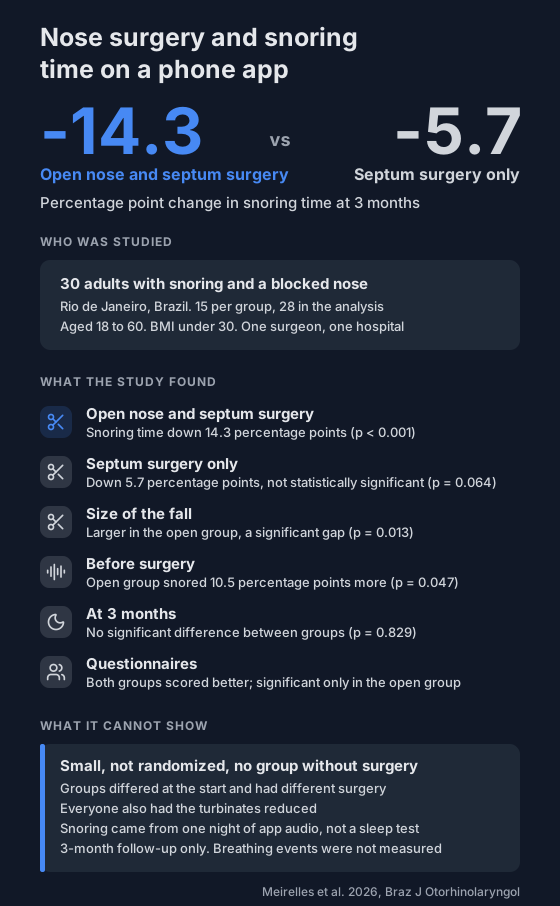
A 2026 Brazilian study of 30 adults used a snore recording app before and 3 months after nose surgery. Snoring time fell 14.3 percentage points after open nose and septum surgery, and 5.7 points, not statistically significant, after septum surgery alone.
Snoring and a blocked nose often go together, and nose surgery is sometimes offered for both. A small, non-randomized 2026 study from Brazil used a snore recording app to see how much snoring time changed after two kinds of nose surgery.
Only one of the two groups showed a statistically significant fall.
Who was in the study?
- 30 adults with snoring and a blocked nose that hadn't responded to medical care. They were booked for nose surgery at a university hospital in Rio de Janeiro.
- Aged 18 to 60. People with a BMI of 30 or more, a large neck, enlarged tonsils or adenoids, or chronic sinus inflammation were left out.
- The patients were put into two groups of 15 by the anatomy of their nose, not at random.
- Group 1 had complex septal deviations and weak, collapsing nasal valves, with visible changes to the nose. They had open nose and septum surgery with cartilage grafts (rhinoseptoplasty).
- Group 2 had septal deviations inside the nose only. They had endoscopic septum surgery (septoplasty).
- Both groups also had the lower nasal turbinates reduced, and one surgeon did every operation.
How was snoring measured?
- Each person recorded three nights with a snore recording app, before surgery and again 3 months after.
- The middle night of each three was used.
- The result was snoring time as a percentage of sleep time.
- One person in each group was dropped as an outlier, so 28 people were in the main comparison.
- The people were also asked about nasal blockage, daytime sleepiness, snoring impact, sleep apnea risk and appearance of the nose, using standard questionnaires.
What did the study find?
- Open nose and septum surgery (Group 1). Snoring time fell by 14.3 percentage points, a statistically significant change (p < 0.001).
- Septum surgery only (Group 2). Snoring time fell by 5.7 percentage points, which was not statistically significant (p = 0.064).
- Size of the fall. The fall was significantly larger in Group 1 than in Group 2 (p = 0.013), but Group 1 also started higher.
- Before surgery. Group 1 had snored 10.5 percentage points more of the night than Group 2 (p = 0.047).
- At 3 months. The two groups did not differ significantly (p = 0.829).
- Questionnaires. Both groups scored better on every scale. Only Group 1 had statistically significant drops, on the nasal blockage and snoring impact scores. Changes in the sleepiness and nose appearance scores weren't significant.
- Blocked-nose score and snoring time. The two were only weakly related, before surgery (ρ = 0.19) and after (ρ = 0.16), and neither was statistically significant.
The paper doesn't print the average snoring time for each group, only the differences. The Group 2 fall was smaller and the study was small, so it can't say whether septum surgery alone changes snoring time a little or not at all.
What doesn't it tell you?
- That surgery caused the change. There was no randomization and no group without surgery, so chance, a placebo effect and natural change over 3 months can't be ruled out.
- Which part of the operation did it. Everyone also had the turbinates reduced, and the two groups had different surgery and different noses, so they can't be compared like for like.
- That it applies to you. 30 people, one surgeon, one hospital, no pre-set sample size calculation, and only a 3-month follow-up.
- How many nights it covers. Snoring time came from one recorded night per stage, and the app picks up sound only. For how close such apps come to a sleep test, see snore recording app vs a home sleep test.
- Anything about sleep apnea. The study had no sleep test, so it can't say whether breathing events or oxygen levels changed. Snoring and sleep apnea are not the same thing.
The authors call for larger studies with longer follow-up and direct airflow measurements.
What can you do with this?
Whether nose surgery suits anyone is a decision for them and their doctor, and this study can't answer it.
If you snore, you can log it for yourself. An overnight oximeter doesn't record sound, but it does record your oxygen and pulse, which a snore app can't. Snoring apps and oximeters covers what each one shows.
If you snore loudly, someone has seen you stop breathing, or you're tired in the day, see a doctor. The sleep apnea risk check takes about a minute and helps you decide whether to raise it.
Not a medical device. Does not diagnose, treat or prevent any condition. Discuss results and changes with a clinician.
References
- Meirelles RC, Tepedino MS, Vianna PM, Oliveira JPRC. The impact of nasal valve surgery on snoring. Brazilian Journal of Otorhinolaryngology. 2026;92(6):101887. Online ahead of print. doi:10.1016/j.bjorl.2026.101887