Neck Size by Hand vs Tape: A 2026 Study
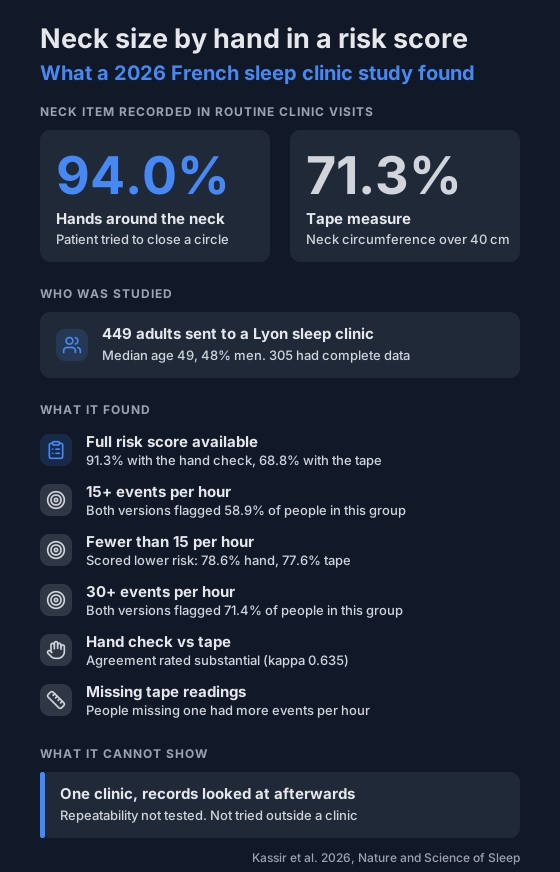
In a French sleep clinic, a hand check of neck size was recorded for 94.0% of patients against 71.3% for a tape measure, and the NoSAS risk score flagged the same share of people with 15 or more breathing events per hour either way.
A thick neck is one of the known risk factors for sleep apnea. That's why several risk scores used by doctors include a neck measurement. One of them is the NoSAS score, built from five clinical items, one of which is a neck circumference over 40 cm.
A 2026 study from Lyon asked a practical question. If the tape measure is often skipped, does a quick hand check work just as well inside the score?
How did the hand check work?
The patient wrapped both hands around their own neck and tried to make the thumbs and middle fingers meet. If they couldn't close the circle, the neck item counted as positive.
The authors call this version "NoSAS hand". They stress it isn't a direct stand-in for a measured neck size.
Who was studied?
- 449 adults sent to a hospital sleep clinic in Lyon, France, between September and December 2025.
- All were referred because sleep apnea was suspected.
- Median age 49.3, and 48% were men.
- Medical students recorded both neck checks during routine visits, without knowing what the study was about.
- An overnight lab sleep study was the reference.
- The median was 25 breathing events per hour, and 43.1% had 30 or more.
What did it find?
- How often it was recorded. The hand check was noted for 94.0% of patients, the tape measure for 71.3%.
- Full score available. That lifted the share of patients with a complete score from 68.8% to 91.3%.
- Agreement. The two neck checks agreed well, which the authors rate as substantial (kappa 0.635).
- At 15 or more events per hour. Among 305 people with both scores and a sleep study result, both versions flagged 58.9% of this group. Among people below 15, the hand version scored 78.6% as lower risk, the tape version 77.6%.
- At 30 or more events per hour. Both flagged 71.4%. Among people below 30, the figures were 68.8% and 68.3%.
None of these gaps was statistically significant. On its own, the hand check picked up slightly more people than the tape, but that wasn't significant either.
Who had a missing tape reading?
People without a tape measurement had similar age, sex and BMI to the rest. But they had more breathing events per hour on average, and more of them had 30 or more. So the gaps weren't random, and that could skew the comparison.
What can't this study show?
- Other settings. It was one specialist clinic, where sleep apnea was more common than in the general population. The score picked up fewer people here than in earlier NoSAS studies.
- Repeatability. Nobody did the hand check twice or had a second person check it.
- Why. Hand size, height and exact neck size weren't recorded, so the reason for the small differences is unclear.
- Everyone. It may not suit people who can't use both arms or hands.
- Design. The data was routine clinic records, analysed afterwards.
The authors say it needs testing in other places, including repeatability, before wider use.
Who wrote it?
One author, Raphael Heinzer, is also an author of the original NoSAS paper. Several authors report fees, honoraria or travel support from companies including ResMed, Philips, Inspire, Löwenstein, Apnimed, Nyxoah, Linde and drug makers. Three of them state theirs are outside this work. The paper lists no funding source for the study.
What can you do with this?
This study tested a clinic risk score, not a home test. The hand check was one item in a score that clinic staff filled in.
If you snore, someone has seen you stop breathing in your sleep, or you're tired during the day, see a doctor. Not sure whether to? The sleep apnea risk check takes about a minute and helps you decide. For the common signs, read snoring vs sleep apnea.
An overnight oximeter can't tell you whether you have sleep apnea. It records what your oxygen and pulse did, and you can share that with your doctor.
Not a medical device. Does not diagnose, treat or prevent any condition. Discuss results and changes with a clinician.
References
- Kassir S, Rabec C, Heinzer R, Von Garnier C, Latreche L, Hajji S, Ricordeau F, Stauffer E, Peter-Derex L, Tankéré P. Patient-Performed Neck Encirclement Within the NoSAS Score: Score Availability and Diagnostic Performance in a Tertiary Sleep Centre. Nature and Science of Sleep. 2026;18:646897. doi:10.2147/NSS.S646897
- Marti-Soler H, Hirotsu C, Marques-Vidal P, Vollenweider P, Waeber G, Preisig M, Tafti M, Tufik SB, Bittencourt L, Tufik S, Haba-Rubio J, Heinzer R. The NoSAS score for screening of sleep-disordered breathing: a derivation and validation study. The Lancet Respiratory Medicine. 2016;4(9):742-748. doi:10.1016/S2213-2600(16)30075-3