Mouth Taping and a Blocked Nose: 2026 Review
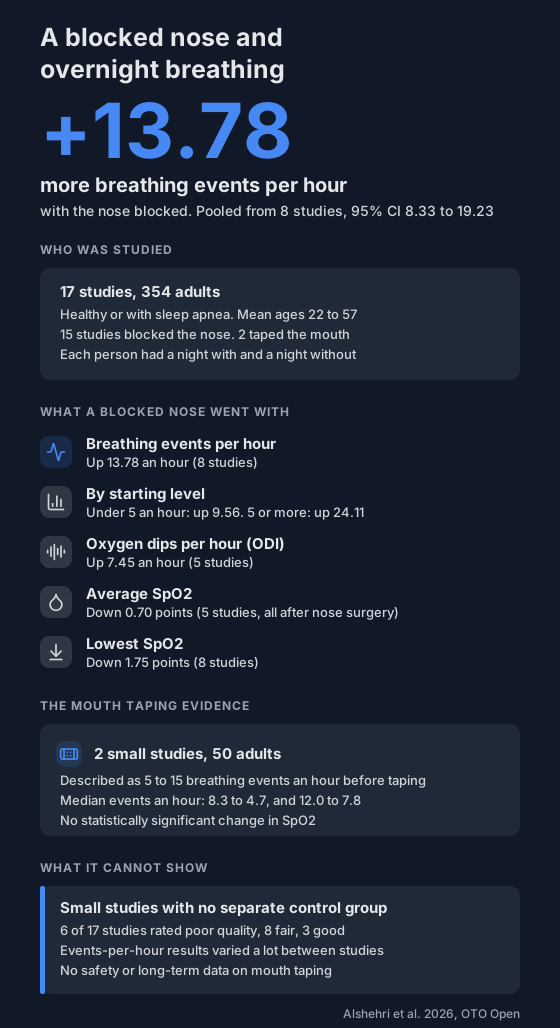
A 2026 meta-analysis of 17 small studies found a blocked nose went with 13.78 more breathing events per hour. Only two studies, with 50 adults, tested mouth taping.
Mouth taping is sold as a way to keep you breathing through your nose at night. A 2026 review pooled the studies on what happens to overnight breathing when the nose is blocked, and the few on taping.
What did the review cover?
- 17 studies with 354 adults, some healthy and some with obstructive sleep apnea.
- 15 studies (304 adults) blocked the nose: packing after nose surgery or for a nosebleed, or packs, clips or masks in an experiment.
- 2 studies (50 adults) taped the mouth shut.
- Each person had at least one night with and one night without.
What happened with the nose blocked?
- Breathing events per hour: up 13.78 (8 studies).
- ODI: up 7.45 dips per hour (5 studies).
- Average SpO2: down 0.70 points (5 studies, all after nose surgery).
- Lowest SpO2: down 1.75 points (8 studies).
The authors call the rises in events and oxygen dips clinically meaningful, and the SpO2 changes too small to be.
People who started with 5 or more events an hour saw the larger rise: 24.11 an hour, against 9.56 for those who started under 5.
What about mouth taping?
Only two small studies, both rated fair quality. The review describes all 50 adults as mouth breathers with 5 to 15 breathing events an hour.
- 20 adults: median events per hour went from 8.3 to 4.7, and ODI from 8.7 to 5.8.
- 30 adults: median events per hour went from 12.0 to 7.8.
- Average SpO2 in the first study and lowest SpO2 in the second showed no statistically significant change.
The authors say the lack of evidence has discouraged its use in clinical practice. Data on safety, adherence and long-term use are still missing, they add.
What can't it show?
- Cause. Most studies were observational: the same people with and without, and no separate control group.
- Everyday congestion. The nose was blocked with packs, clips or masks, not by a cold or hay fever.
- Quality. 6 of the 17 studies were rated poor, 8 fair and 3 good.
- Consistency. The events-per-hour results varied a lot between studies, which defined a breathing event differently.
What can you do with this?
If you're thinking about mouth taping, talk to a doctor first.
If your nose is often blocked at night, tag those nights and compare them with clear ones. Does a blocked nose lower overnight oxygen? explains how, and compare nights puts two recordings side by side.
An oximeter records oxygen dips and pulse, not breathing events. It can't tell you whether you have sleep apnea.
Not a medical device. Does not diagnose, treat or prevent any condition. Discuss results and changes with a clinician.
References
- Alshehri NA, Alsaif NF, Abdulrazaq AN, Jabor RM, Al-Sayed AA. Impact of Nasal Obstruction and Mouth Taping on Sleep Apnea Indicators: Systematic Review and Meta-Analysis. OTO Open. 2026;10(3):e70294. doi:10.1002/oto2.70294