Chronic Hives and Sleep: A 2026 Study
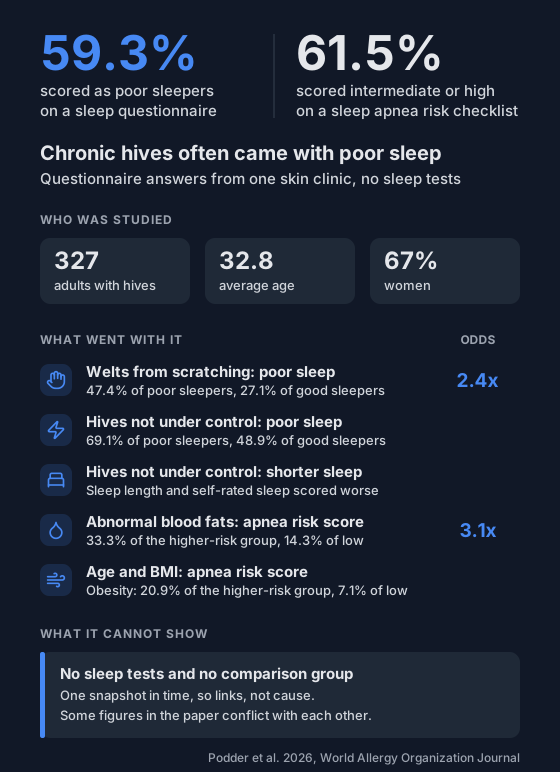
A 2026 study of 327 adults with chronic hives found 59.3% scored as poor sleepers and 61.5% scored intermediate or high on a sleep apnea risk questionnaire. No sleep tests were done.
Chronic hives are itchy welts that keep coming back for more than 6 weeks with no clear trigger. Doctors call it chronic spontaneous urticaria.
A study published in September 2026 asked 327 adults with the condition about their sleep. About six in ten scored as poor sleepers.
Who was in the study?
- 327 adults aged 18 to 65 at one skin clinic in Kolkata, India.
- Average age was 32.8 and 67% were women.
- 60.9% had hives that weren't under control, based on a symptom score.
- Nobody had asthma or had taken a sedating antihistamine in the past 7 days.
Everyone filled in a sleep quality questionnaire and STOP-Bang, a sleep apnea risk checklist.
How did they sleep?
- 59.3% (194 of 327) scored as poor sleepers.
- 47.4% of poor sleepers had welts brought on by scratching, against 27.1% of good sleepers (2.4 times the odds).
- 69.1% of poor sleepers had hives that weren't under control, against 48.9% of good sleepers.
- People with uncontrolled hives scored worse on sleep length and on how they rated their own sleep.
- Abnormal blood fats were less common in poor sleepers: 19.6% against 35.3%.
There was no comparison group. The authors cite another Indian study where 36.3% of healthy people slept poorly.
What about sleep apnea risk?
- 53.5% scored intermediate risk and 8% scored high risk.
- The score rose with age and BMI.
- 20.9% of the higher-risk group were obese, against 7.1% of the low-risk group.
- 33.3% of the higher-risk group had abnormal blood fats, against 14.3% (3.1 times the odds).
Nobody had a sleep study, so the paper can't say how many had sleep apnea.
What doesn't it tell you?
- Cause. It's a single snapshot, so it can't show which comes first.
- Everyone. One clinic, mostly younger adults.
- Consistent numbers. The paper lists being female (odds ratio 12.3) and uncontrolled hives (2.7) as predictors of a higher risk score, but its own table shows the opposite: women were 92.9% of the low-risk group and 49.3% of the higher-risk group, and uncontrolled hives were 75.4% against 51.7%.
What can you do with this?
If itching wakes you at night, tell the doctor who looks after your hives.
If you also snore loudly or someone has heard you stop breathing, read snoring vs sleep apnea or try the sleep apnea risk check.
An overnight oximeter can't tell you whether you have sleep apnea. It records your oxygen and pulse, and you can share that with your doctor.
Not a medical device. Does not diagnose, treat or prevent any condition. Discuss results and changes with a clinician.
References
- Podder I, Nath S, Sadhukhan S, Robles-Velasco K, Cherrez-Ojeda I. Sleep quality, disturbance and the prevalence of obstructive sleep apnoea in chronic spontaneous urticaria and associated risk factors. World Allergy Organization Journal. 2026;19(10):101464. doi:10.1016/j.waojou.2026.101464