How Accurate Is AI at Spotting Sleep Apnea?
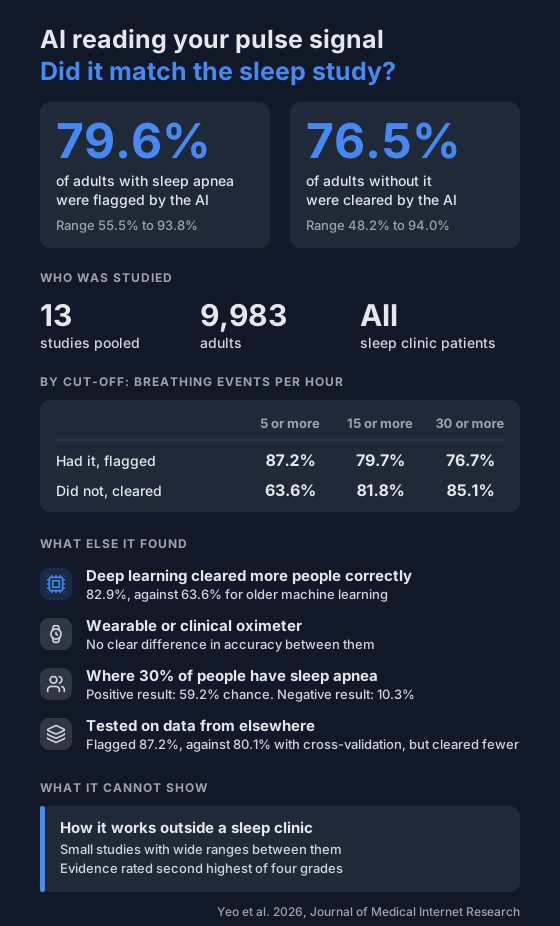
A 2026 meta-analysis pooled 13 studies and 9,983 adults. AI reading an oximeter's pulse signal flagged 79.6% of people with sleep apnea and cleared 76.5% of those without it.
A pulse oximeter shines light through your finger and records a pulse wave called PPG (photoplethysmography). Researchers have been training AI models to read that signal and say whether someone has obstructive sleep apnea.
A meta-analysis published in September 2026 pooled the results.
What did the review look at?
- 13 studies with 9,983 adults, found by searching five databases up to November 2025.
- All were cross-sectional, and every participant was a sleep clinic outpatient.
- Average ages ran from 42 to 69.
- 12 compared the AI against a lab sleep study, and one against a home sleep test.
How often did the AI get it right?
- Of the people who had sleep apnea, the AI flagged 79.6%.
- Of the people who didn't, it cleared 76.5%.
The ranges around both were wide: 55.5% to 93.8%, and 48.2% to 94.0%.
Where 30% of people have sleep apnea, the authors put the chance of having it at 59.2% after a positive result and 10.3% after a negative one.
Did the cut-off matter?
Sleep studies count breathing events per hour, with cut-offs of 5, 15 and 30.
- At 5 or more, the AI flagged 87.2% of those who had it and cleared 63.6% of those who didn't.
- At 15 or more: 79.7% and 81.8%.
- At 30 or more: 76.7% and 85.1%.
At higher cut-offs it wrongly flagged fewer people. It also seemed to miss more, but that difference was uncertain.
What else did it find?
- Model type. Deep learning models cleared 82.9% of people without sleep apnea, against 63.6% for older machine learning.
- Device. Wearable smart devices and clinical oximeters showed no clear difference.
- Testing method. Studies tested on data from elsewhere flagged 87.2%, against 80.1% for cross-validation, but cleared fewer.
What doesn't it tell you?
- How it works at home. Everyone was already a sleep clinic patient.
- A precise figure. The studies were few, mostly small, and varied a lot.
- The effect of weight. There wasn't enough data on BMI.
The authors rated the evidence the second highest of four grades. Risk of bias was rated low in 7 studies and unclear in 6. One author is involved with an AI company.
What can you do with this?
No AI result replaces a sleep study. If you snore loudly or someone has heard you stop breathing, see a doctor. Not sure? Try the sleep apnea risk check.
PulseOxTracker doesn't run any of these models. It shows the oxygen and pulse your oximeter recorded, including your ODI, and you can share that with your doctor.
Not a medical device. Does not diagnose, treat or prevent any condition. Discuss results and changes with a clinician.
References
- Yeo BSY, Gao EY, Tan JEX, Koo JY, Lee YS, Tan NKW, Ng ACW, Leong ZH, Ong TH, Leow LC, Huang GB, Tan BKJ, Toh ST. Accuracy of Artificial Intelligence in Diagnosing Obstructive Sleep Apnea Using Photoplethysmography: Systematic Review and Meta-Analysis. Journal of Medical Internet Research. 2026;28:e78718. doi:10.2196/78718