AI and Overnight Oximetry: How Accurate?
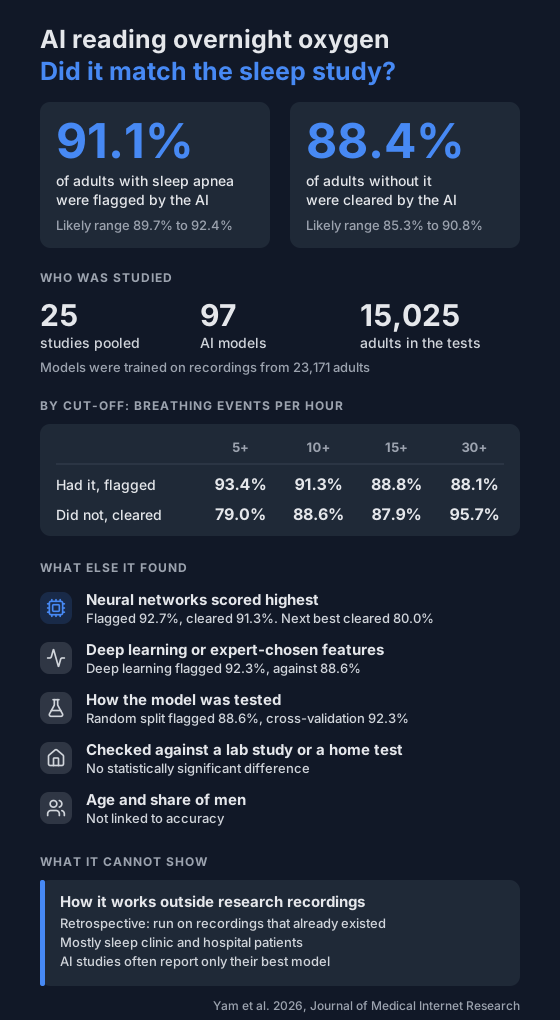
A 2026 meta-analysis pooled 25 studies and 97 AI models. AI reading overnight oxygen alone flagged 91.1% of adults with sleep apnea and cleared 88.4% of those without it.
An overnight oximeter records your blood oxygen all night. Researchers have been training AI models to read that recording on its own and say whether someone has obstructive sleep apnea.
A meta-analysis published in July 2026 pooled how often the AI agreed with a sleep study.
What did the review look at?
- 25 studies testing 97 AI models, from five databases searched up to January 2026.
- The models were trained on recordings from 23,171 adults and tested on 15,025.
- 22 studies compared the AI against a lab sleep study, and 3 against a home sleep test.
How often did the AI get it right?
- Of the people who had sleep apnea, the AI flagged 91.1%.
- Of the people who didn't, it cleared 88.4%.
The authors compare that with counting oxygen dips alone, the ODI. They cite earlier studies where ODI flagged over 90% of people who had it but cleared only 40% to 60% of the rest.
Did the cut-off matter?
Sleep studies count breathing events per hour.
- At 5 or more, the AI flagged 93.4% of those who had it and cleared 79.0% of those who didn't.
- At 15 or more: 88.8% and 87.9%.
- At 30 or more: 88.1% and 95.7%.
At higher cut-offs it wrongly flagged fewer people and missed a few more.
What else did it find?
- Model type. Neural networks did best of five types: 92.7% flagged, 91.3% cleared. Support vector machines flagged the same share but cleared 80.0%.
- Features. Deep learning flagged 92.3%, against 88.6% for models using features chosen by experts.
- Testing method. Models tested on a random split of the data flagged 88.6%, against 92.3% with cross-validation.
- Age and sex. Neither was linked to accuracy.
What doesn't it tell you?
- How it works at home. Most participants were sleep clinic or hospital patients, and the studies were retrospective, run on recordings that already existed.
- Real-world accuracy. The authors say AI studies often report only their best model.
- The type of event. Oximetry can't reliably tell obstructive from central apnea.
The authors' summary table rates the evidence the highest of four grades, but their text calls it the second highest. They say AI is unlikely to replace a sleep study.
What can you do with this?
These were research models, and home oximetry is not a sleep study.
- For AI reading the pulse wave instead, see this related review.
- Worried about sleep apnea? Try the risk check and talk to your doctor.
Not a medical device. Does not diagnose, treat or prevent any condition. Discuss results and changes with a clinician.
References
- Yam KJM, Lim CYJ, Gao EY, Koh JH, Tan NKW, Ng ACW, Leong ZH, Phua CQ, Ong TH, Leow LC, Huang GB, Tan BKJ, Toh ST. Artificial Intelligence Diagnosis of Obstructive Sleep Apnea Using Overnight Pulse Oximetry: A Systematic Review and Bayesian Meta-Analysis. Journal of Medical Internet Research. 2026;28:e80349. doi:10.2196/80349